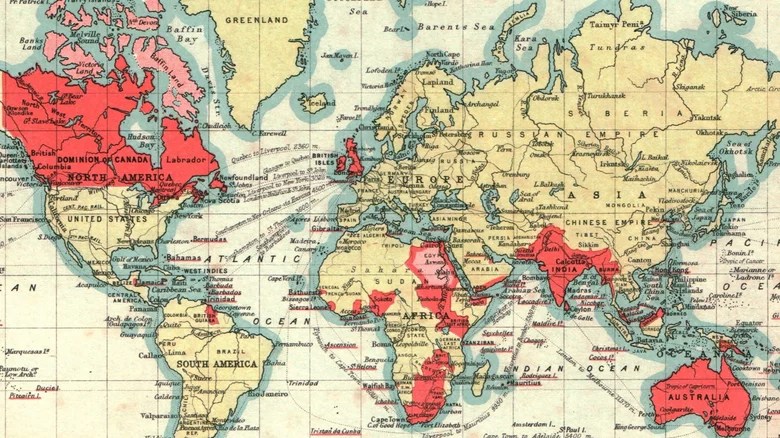
This essay was originally written under the title: The Fallacy of Nineteenth-Century Hegemonic Britain: A Reappraisal in Favour of ‘Strategic Primacy’
Introduction
With a re-engaged US, a more assertive China and talk of EU strategic autonomy, scholars and commentators are again considering the implications for future world orders and the potential for hegemonic transition. Despite the concept playing a significant role in international relations, there has yet to be an agreed definition of hegemony (Davis, 1997; Ferguson, 2004) or consensus on approaches for assessing hegemony in history (Antoniades, 2018). However, at its most basic level, hegemony is “a concept meaning primacy or leadership” whereby a state in the international system can dominate through coercion or consent of other states who may ally with, react against or remain apathetic towards it (Evans & Newnham, 1998, p. 221). The term hegemon denotes the state with the most power, while hegemony is the span of its dominance (Antioniades, 2018). As Levy argues, hegemons create an international order that reflects their interests before their period of hegemony is challenged through economic competition, overstretching or ‘hegemonic war’ (Levy, 1994). While there is consensus on US hegemony after 1945 (Cox,1987; Gilpin, 1990; Wallerstein, 1983; Stein, 1984; O’Brien, 2003), other historical examples are varied and contentious. Wallerstein argues that three hegemonic powers have existed in the history of capitalism, including the United Provinces in the seventeenth century, Britain in the nineteenth century and the US in the twentieth century (Wallerstein, 1983). However, as Patrick O’Brien points out, others might even add the Roman Empire and the Italian city-states of the fifteenth century (O’Brien, 2003).
The idea of British hegemony has been significantly challenged over the years. For example, the scholar O’Brien has called British hegemony “a myth,” arguing that Britain played no active role in establishing, leading or coordinating a global order (O’Brien, 2003, p. 113). Similarly, Lacher, Germann, and Nye have challenged British hegemony, questioning British agency, its leadership on free trade and its role in establishing and maintaining an international liberal order (Lacher & Germann, 2012), (Nye, 1991).
This essay will posit that nineteenth-century Britain was not a hegemonic power leading a liberal international order and that Britain’s historical position as a ‘great power’ would be better explained through the concept of ‘strategic primacy’.
This essay will comprise five sections. The first will justify the period 1815 to 1914 as the timeline for the investigation. The second will review the debate on British hegemony. The third section will present a case against British hegemony in three arguments. Firstly, it will argue that Britain lacked the agency and influence necessary to lead a liberal order. Secondly, existing narratives ignore or lessen the impact of other states in forming an international order, and finally, British strengths commonly associated with hegemony have been overstated and require recalibration. The fourth section will challenge the simplistic construction of hegemony as a concept arguing that a case could be made for French hegemony, undermining its usefulness as a descriptor of the British position. Finally, the fifth section will make a case for ‘strategic primacy’ as a more suitable conceptual framing for understanding nineteenth-century Britain – a Britain that gained primacy within a multipolar order where it operated strategically, given its narrow lead in the international system.
Section 1: Timeframe for Analysis – 1815 to 1914
There are differing opinions on when Britain was hegemonic. Proponents of World System Theory see Britain’s ‘ascending hegemony’ as taking place between 1815 to 1850, its ‘hegemonic victory’ as spanning 1850 to 1875, before maturity was maintained between 1875 to 1914 and finally decline set in between 1914 and 1945 (Cupitt, Whitlock & Whitlock, 1993). Gilpin suggests that ‘Pax Britannica’ was at its pinnacle between 1849 and 1880 (Gilpin, 1981). Cox suggests British hegemony existed between 1845 and 1875, with the transition to free trade and British economic dominance (Cox, 1983). Given the variation in timeframes, this essay will focus on Britain between 1815 and 1914. It begins in 1815 when Britain was widely recognised as being in a newly dominant position. It ends with the advent of the First World War, a year when Germany challenged Britain’s dominance in a global war.
Section 2: The Debate on British Hegemony
The notion of British hegemony remains contentious and continues to divide scholars. The realist Robert Gilpin argues that nineteenth-century Britain and the United States are examples of hegemonic powers that set out to arrange world order through the provision of ‘public goods’ including free trade, security, investment and financial rules and mechanisms (Gilpin, 1981). Gilpin argues that Britain’s hegemony started with the acceptance of free trade by the middle class in the early nineteenth century and peaked between 1849 and 1880 with Britain adopting a foreign policy to establish “a world market economy based on free trade, freedom of capital movements and a unified monetary system” (Gilpin, 1981, p. 138). Gilpin argues that Britain’s hegemonic position over the global economy was maintained due to its role as a European ‘balancer’, its naval dominance and its provision of public goods (Gilpin, 1981).
Like many others, Gilpin supports the idea that hegemony is inherited through history. He notes the passing of hegemony from Pax Romana to Pax Britannica and then Pax Americana (Gilpin, 1981). The idea of succession brings to attention one of the most influential theories of international relations: Hegemonic Stability Theory (HST).
Alongside Gilpin, its proponents include Charles Kindleberger and Stephen Krasner. The theory’s premise is that a hegemonic power provides stability within the international system over which it presides. This stability is maintained due to the hegemon’s inducements to other ‘follower’ states in the system. However, instability can return if other powers contest the hegemon. In presenting his idea, Kindleberger focused on the Great Depression, arguing that the international economy needed a state to act as a leader where it sets the rules, manages a global currency and “takes on an undue share of the burdens of the system”, especially during times of global stress (Kindleberger, 1987, p. 11). For Kindleberger, Britain had undertaken this role before the outbreak of the First World War, abandoning it ahead of the 1933 World Economic Conference, which, in his view, worsened the depression (Kindleberger, 1987, p. 296). In contrast, McKeown argues that nineteenth-century Britain does not fit the theory given Britain’s inability to influence and convince others to liberalise their economies during the period (McKeown, 1983).
Other proponents of British hegemony include Julian Go, who assigned British hegemony or ‘unicentrism’ between 1815 and 1873 when Britain was the world’s dominant economic power. Go suggests that Britain had enough confidence in its hegemonic strength that it was no longer worried about France and could ignore its attempts to seize colonial outposts in the Pacific or areas closer to home (Go, 2015). However, the notion of British confidence is challenged by Lacher and Germann, who dispute British strength, arguing that Britain feared France during the period, especially in light of French naval advances and Britain’s likely inability to repel an invasion (Lacher & Germann, 2012).
In examining Britain’s hegemonic behaviour, Dacey and Murrin label Britain a “subtle commercial hegemon” (Dacey & Murrin, 1997, p. 205), arguing that Britain rarely used military force to encourage other states to open their markets, liberalise their economies and join a British-led order. Instead, they posit that Britain transitioned unilaterally to free trade, which increased trade, and provided ‘public goods’, thereby inducing other powers to support British leadership. In contrast, Davis argues that Britain lacked the will to lead and the mechanics necessary to orchestrate or administrate a global economic order. Furthermore, he suggests that other states adopted liberalisation on their terms and only when it became clear that their economies had the potential to benefit from the change (Davis, 1997).
Neo-Gramscians also subscribe to the idea of British hegemony. Forming a critical school of theory inspired by the Italian Marxist political philosopher Antonio Gramsci (1891 – 1937), they focus on the role of agency and social forces, suggesting that domestic hegemony is required before international hegemony can occur. In making his case, Cox argues that British Prime Minister Robert Peel achieved national hegemony in the 1840s by implementing reforms, such as repealing the Corn Laws, Navigation Acts and introducing employment legislation. In doing so, he argues British leaders placated the demands of the middle class while pacifying the Chartist demands for political reform. For Cox, with class agitation dealt with and consent achieved, Britain could assume its leadership position and promote a bourgeois foreign economic policy supported across the class spectrum. Here, Cox develops his link between social forces and world orders, arguing that British hegemony was then made international through a mix of mimicry and British agency. He posits that Britain’s hegemonic social classes unified and integrated with their equivalents on the continent. In response, European states became dependent on British money and machinery and began to copy Britain, “adopting the rules and practices of the liberal order as their own guidelines” (Cox, 1987, p. 146). In the neo-gramscian explanation, the changes in Europe can be traced back and linked to the domestic hegemony achieved in Britain.
Similarly, Giovanni Arrighi posits that Britain embraced and promoted free trade as an ideology across Europe, tapping into the recently dominant propertied classes “that formed the natural constituency of British free trade hegemony” (Arrighi, 1994, p. 56). Moreover, citing the link between property and democracy, he argues that Britain decided to nurture democratic evolution in other states to expand and deepen its power and influence across the international community (Arrighi, 1994). However, this view is challenged by Latham, who argues that Britain showed little interest in helping liberal movements across Europe and that reform movements such as that led by revolutionary leader Garibaldi in Italy were unlikely to secure much British Support. Moreover, he points out that interference in European states was not a significant part of British strategy since Castlereagh’s dismissal of foreign state intervention in the 1820s and despite the more assertive Palmerston administration (Latham, 1997).
British hegemony continues to spark debate in academic circles, with many contending that British economic might, its efforts on free trade, its provision of public goods and its role as a European ‘balancer’ accord it the status of a hegemon. In contrast, are opponents who argue that Britain’s lack of agency combined with its inability to influence others and its fear of France negate the case for hegemony. Within the debate, scholars have struggled to make hegemony fit for Britain. Talk of ‘subtle commercial hegemon’ (Dacey & Murrin, 1997), ‘half-hegemony’ (Schroeder, 1994), and ‘singular hegemony’ (Clark, 2011) suggest the term struggles to explain Britain’s historical position. Moreover, it raises the question of whether the term is suitable in the first place and whether a better definition is necessary.
Section 3: The Fallacy of British Hegemony
This section will refute the idea of British hegemony by focusing on three arguments. Firstly, it will argue that Britain lacked the agency and influence necessary to lead a liberal order. Secondly, existing narratives ignore or lessen the impact of other states in forming an international order, and finally, British strengths commonly associated with hegemony have been overstated and require recalibration.
Absence of Agency & Influence
Nineteenth-century Britain lacked both the necessary impetus to lead and the ability to influence, undermining the case made for British hegemony.
The transition to free trade and the liberalisation of tariffs was driven mainly by national politics, with no one in high office imagining a role for Britain as the coordinator or manager of an international regime of public goods (O’Brien & Pigman, 1992). Moreover, unlike France, Lacher and Germann argue that Britain was not at the forefront of pushing for European-wide liberalisation. It showed no tendency towards establishing or promoting regulations to support economic liberalisation (Lacher & Germann, 2012). The role of the British government was also largely passive, with the Foreign Office undertaking no proactive intervention or diplomacy on behalf of British businesses (O’Brien & Pigman, 1992). Moreover, while British investment, exports and technology played an important role in economic development, liberalisation efforts were led more by domestic and commercial entities than by the British government acting as a global actor (Latham, 1997).
The notion that Britain was instrumental in leading the global economy, as proposed by proponents of HST, does not withstand scrutiny. In contrast to Howe’s argument that the Bank of England was the “lender of last resort for the world as a whole” (Howe, 2004, p. 29), the power of the Bank of England was limited. As O’Brien points out, the Bank’s control extended only to the colonies and was not global. Moreover, he points out that the Bank never undertook initiatives to promote, standardise or convert states to adopting the gold standard, suggesting that “any presumed analogy to an orchestration of central banks conducted from London is without substance” (O’Brien, 2003, p. 125). Contrary to what hegemonic proponents would have us believe, Britain was not the world’s economic conductor.
Another factor undermining the case for British hegemony is Britain’s inability to influence others to follow its lead. As Davis argues, Britain lacked the influence, mechanisms and ability to convert others to free trade (Davis, 1997), while Turner points out that despite the expectations of free trade advocate Richard Cobden, few states quickly followed Britain’s example in reducing their tariffs (Turner, 1971). Moreover, Britain’s unilateral transition to free trade had robbed its trade envoys of any inducements or tools that could be leveraged to encourage the opening of European markets (Lacher & Germann, 2012). Britain’s powerlessness was further exposed by its inability to avert a pivot back to protectionism later in the century, even within its colonial possessions (Pigman, 1997; Howe, 2004). As Howe suggests, Britain “remained an impotent spectator in an age of growing tariff warfare” (Howe, 2004, p. 30). Britain lacked a following suggesting the term hegemon might be misplaced.
Britain’s influence is further undermined when examining its trade relations with European states and its response to European economic events. For example, Britain was lacklustre in responding to the economic threat posed by central Europe’s protectionist Zollverein customs union, with attempts at keeping Frankfurt out of the union unsuccessful and efforts at influencing the custom’s tariffs failing miserably, compounding previous failed efforts at influencing European tariffs (McKeown, 1983). The same lack of influence can be seen in Britain’s free trade negotiations with Austria in the 1860s, which faced significant opposition from the Austrian middle class and liberal circles (Helleiner, 1973). The lack of influence with Austria also undermines neo-Gramscian explanations for British hegemony. Neo-Gramscians posit that British hegemonic social classes united in a common cause with their European equivalents. However, in Austria, as Helleiner points out, Britain faced a middle class opposed to free trade, the opposite situation to that experienced in Britain (Helleiner, 1973).
As the evidence shows, Britain’s global leadership and influence were limited. Britain was focused on domestic policy and did not see itself as an international leader. Moreover, Britain neither wanted nor imagined a role where it was responsible for the creation and management of an international order under British direction. Furthermore, Britain was often more passive than other powers, leaving liberalisation efforts to commercial entities without government support. As a result, Britain’s influence was limited. Despite widespread hopes, others did not quickly follow its unilateral move to free trade. In addition, Britain’s abandonment of its traditional trade negotiation tools left it unable to encourage others to join it or to prevent a return to a world of economic barriers. Britain’s inability to garner followers and encourage others to adopt and maintain its position further undermines the evidence favouring British hegemony.
A Non-Hegemonic, Multipolar Order
The notion of an international order led by a hegemonic Britain ignores the role played by other states in leading efforts on free trade, liberalisation, diplomacy and institutional development. On reflection, Britain was one power among many vying for supremacy in a multipolar international order, with some powers taking a more assertive leadership stance in international economic affairs.
In contrast to the idea of public goods provided by the hegemon, others argue that Britain existed in a multipolar world where states collaborated in creating mechanisms and regimes within the international system. For example, in highlighting the transition to the gold standard, Latham argues that the effort was a collective endeavour, where European states looked to collaborate to ensure economic stability. It demonstrated in his view that the international order was, in fact, a “patchwork of overlapping systems and orders” (Latham, 1997, p. 443).
The role played by other states also recalibrates the debate. France took significant steps in its ambition to effect economic liberalisation and cooperation at an international level. For example, France hosted two major International Monetary Conferences in 1865 and again in 1867, bringing together over twenty countries, including Britain, the USA, Russia and Japan, to discuss an international regime for currency integration and harmonisation (Einaudi, 2018). Similarly, Nye also calls to attention French leadership, arguing that France’s trade policy was far more liberal than Britain’s, even during the peak of Britain’s efforts at repealing its tariffs (Nye, 1991). Somewhat surprisingly, France’s role is also recognised by Kindleberger, who acknowledges France’s role in cooperating with Britain on currency rates and in the coordination of national financial policies (Kindleberger, 1981). As this essay will outline in the next section France played a significant role which is often neglected at the expense of a narrative that attributes the liberal international order to British hegemony.
Turning to the diplomatic front, Levy uses Paul Schroeder’s international relations theory to point out that the Concert of Europe was not subject to British balancing. Schroeder argues that the balancer role does not necessarily sit with the strongest power. For Schroeder, Austria and Germany were the most influential and dominant powers, given their central position in Europe. Moreover, Schroeder counters the idea of balance and posits that instead, the system was based on the reciprocal understanding among the five great powers of the Concert, where significant changes to state boundaries and potential conflicts were resolved collectively (Levy, 1994).
The nineteenth century saw a powerful Britain, but not a hegemonic one. In reality, following the Treaty of Vienna in 1815, the world moved into a multipolar phase that comprised five major powers by mid-century. Efforts to establish international regimes and institutional mechanisms were not only the work of Britain; France was heavily engaged in co-creating an emerging international order, often in direct collaboration and coordination with Britain. Furthermore, since 1815, Britain’s role had evolved, with Austria and Germany playing more prominent roles in the Concert. Moreover, efforts to establish international regimes and institutional mechanisms by the likes of France and others challenge the traditional image of an international order designed for and by Britain. Britain was a great power but one among several.
Overstated Strengths
The traditional strengths commonly associated with British hegemony overstate the country’s power. Evaluating British foreign policy, military and naval strength over the period suggests the label of hegemony requires recalibration.
Looking again at Britain during the nineteenth century, we see a country fearful of a French invasion (McKeown, 1983), worried about its ability to defeat French iron clads and existing in a European system where France and Russia were the most feared nations (Lacher & Germann, 2012). Britain was fearful of its nearest neighbour to the point that, according to Prime Minister William Gladstone, it was necessary to sign the 1860 Cobden-Chevalier tariff treaty to mollify the military threat posed by France (Matthew, 1988).
On the foreign policy front, Britain’s power was constrained. Despite its powerful navy, it could seldom influence major European events, including the unification of Italy, the continental-wide revolutions of 1848 and the rise of Germany (Reynolds, 1991). Looking at significant events such as the unification of Italy, it was France, rather than Britain, that played a pivotal role. Similarly, Britain could not intervene to aid Schleswig-Holstein or prevent the rise of Prussia – something the British had long feared (Latham, 1997).
Familiar narratives on British hegemony rely heavily on Britain’s military power and naval prowess. However, traditional narratives mask the actual state of Britain’s military and naval power. In reality, Britain’s army was seen as weak by other European powers, especially after the Crimean War, and this perception lasted until the start of the new century (Latham, 1997). Furthermore, Britain’s army was woefully unfit to fend off a potential continental threat, especially given the refusal of parliament to invest in effective land forces to repel any potential invasion (Lacher & German, 2012). Moreover, Britain’s stretched resources were often hampered by the billeting of troops elsewhere, as was the case with British troops billeted in Canada during the US civil war, which left Britain dangerously exposed (Davis, 2004)
Even the power of Britain’s navy requires recalibration. While its fleet was far more extensive than other European powers, its strength has been overstated, ignoring its limited usefulness in European combat, its poor state of modernity and its overall capability. While the navy was helpful in securing British interests in coastal China or Portugal, it was of little use for continental intervention (Reynolds, 1991). Furthermore, British leaders were also worried about the navy’s ability to counter the French threat in the Mediterranean given French naval strength and its partnership with Russia (Davis, 2004). Aside from capability, Britain’s navy was also falling behind other European powers. As Massie points out, the British were dangerously unprepared for modern warfare throughout the nineteenth century, hampered by outdated ‘Nelsonian’ thinking and the admiralty’s slow response to the innovative launch of France’s first iron-clad Le Gloire’ in 1858 (Massie, 2007).
The narrative of Britain as the pivotal balancer in European affairs backed up by a strong military and formidable navy requires recalibration. Even with the world’s largest navy, it did not feel safe and was left to engage diplomatically or stay out of events it might otherwise have taken a more active role. Moreover, Britain’s intense fear of France, underinvestment and overextension in its navy, combined with its limited capability to intervene and influence, undermines the suggestion that Britain was hegemonic.
Section 4: If British Hegemony, Why Not French?
The point here is not to make a case for French hegemony. Instead, this essay posits that hegemony is too simplistic and that its common attributes and construction could be easily used to describe nineteenth-century France as a hegemonic power, undermining its efficacy in describing the British position between 1815 and 1914.
While the likes of Kindleberger argue that Britain “persuaded Europe, by precept and example,” on free trade (Kindleberger, 1975, p. 51), others question whether France played a more significant role than is traditionally acknowledged. It was, of course, France that approached Britain and initiated free trade negotiations in 1860 (Lacher & Germann, 2012). The French also surpassed British efforts on free trade and economic liberalisation with French trade negotiations leading to the creation of a European free trade regime across thirteen countries, with France even providing trade access within its empire (Stein, 1984). Lacher and Germann concur, pointing out that France “became the hub of a European network of free trade treaties that institutionalised the most-favoured-nation principle” (Lacher & Germann, 2012, p. 109). Nye also breaks up the “myth of free-trade Britain and fortress-France”, arguing that French efforts on liberalisation were more significant than those taken by Britain. He suggests that the fame of the Corn Laws overshadows the French reduction in tariffs which were already much lower than Britain’s to start with (Nye, 1991, p.23).
In contrast to Britain, France demonstrated a desire and ability to lead and influence other states to join its efforts at liberalisation. For example, France established a regime to manage European currencies establishing the Latin Monetary Union in 1865, involving Italy, Belgium, France, Spain, Greece and Switzerland (Fenby, 2015). This example of French leadership also influenced the rise of other institutional regimes, including the Scandinavian Monetary Union, after 1875 (Ryan & Loughlin, 2014).
While none of the scholars above has made a case for French hegemony, their highlighting of French international leadership, the provision of public goods, and the ability of France to garner followers combined with fear of French military strength and its global empire and the liberal nature of the French state itself a case could be argued for French hegemony.
Section 5: Nineteenth-century Britain: A Position of ‘Strategic Primacy’
As argued in this essay, the notion of British hegemony requires recalibration. Making the case against British hegemony inevitably leads to the question of how best to describe Britain’s position between 1815 and 1914.
This essay contends that nineteenth-century Britain enjoyed a position of ‘strategic primacy’, a more precise and accurate descriptor of Britain’s status. In contrast to hegemony, ‘primacy’ recognises that while Britain enjoyed superiority in global finance, trade and colonial expansion, it did not, as this essay points out, lead an international order, nor was it always able to impact continental European affairs. It also accounts for the narrowing of Britain’s economic and naval supremacy while also recognising that Britain existed in a multipolar order co-created with great powers such as Germany and France, the latter of which played an arguably more significant role than Britain in driving early economic liberalisation, as noted earlier in this essay.
The term ‘strategic’ denotes Britain’s grand strategy of naval might, selective intervention and power balancing that maintained its primacy. This section will explain ‘primacy’ before outlining Britain’s grand strategy and providing examples.
The Case for Primacy
Britain did enjoy economic primacy throughout much of the nineteenth century. The country accounted for 40 per cent of manufactured world trade (Kennedy, 1989), 20 per cent of Europe’s gross national product (Reynolds, 1991) and 68 per cent of Europe’s wealth (Mearsheimer, 2001). Moreover, London was at the economic centre of the world, with its institutions managing merchant shipping, insurance, and capital investment (Howe, 2004). However, Britain’s economic lead was narrowing, with industrial expansion slowing compared to its rivals (Thomson, 1978). By the 1870s, the German and the US economy was fast catching up with Britain, with Germany and the United States accounting for 13 percent and 23 percent of world industrial production, respectively (Kennedy, 1989).
The lead enjoyed by the British navy was also narrowing. Following the defeat of Napoleon in 1815, Britain’s navy suffered underinvestment to the point that it risked being unable to conduct a modern war (Adams, 1970). Britain feared the French lead in iron clads (Allen, 1969), the challenge posed by German naval rhetoric and investment (Massie, 2004) and the formidable strength of the US navy, which had built an ocean-going fleet during the civil war in an attempt to blockade the Confederacy and challenge British dominance (Hugill, 2009). Given that Britain’s supposed dominance was threatened as early as the 1860s suggests that primacy rather than hegemony is a better descriptor for its position.
Primacy also better describes the multipolar order in which Britain existed. An order co-constructed with other powers, where Britain’s power and influence were constrained. As argued earlier in this essay, economic liberalisation was not just the preserve of Britain. Similarly, Britain’s role in the balance of power suggests that even as early as the 1820s, Britain struggled to prevent European powers determined to alter the international scene, with French action in Spain and the Austrian invasion of Naples happening despite British reservations (Davis, 2004). Britain was rarely able to act unilaterally, as demonstrated by the Duke of Wellington, who famously remarked that any global action by Britain required French agreement (Hurd, 2007).
The term primacy better explains Britain’s position as the leading economic and naval power while also recognising its narrowing lead, the role of others in the international system and the flaws in arguments that promote the notion of Britain dominating and directing a liberal international order of its own making.
Sustaining Primacy
The fact that Britain could retain its primacy for so long was down to a grand strategy that combined naval might, selective intervention and the balance of power. Britain continued to evolve a ‘blue-water policy’ conceived initially as early as the 1650s that prioritised naval protection in home waters and supported trade and colonial expansion while relying on subsidies to Britain’s allies to take on military engagements for which its army was too small (Baugh, 1988). At around the same time, it relinquished territorial claims in Europe that risked British entanglement while actively seeking to manoeuvre states within the balance of power (Teschke, 2021). While these strategies evolved, Britain in the nineteenth century changed course pivoting away from military intervention in favour of commerce, albeit with the caveat of restricting its rivals’ access (Murray, 1960). Staying true to Castlereagh’s strategy of non-intervention, Britain stayed out of European conflicts, including the revolutions of 1848, the Austrian-Prussian war (1866) and the Franco-Prussian war (1870-71) (Davis, 1943).
This strategy was remarkably successful in ensuring Britain stayed out of European entanglements allowing it to focus on economic and colonial expansion.
With Britain’s grand strategy in place the country could priortise economic, trade and colonial expansion. In line with its grand strategy and long-standing principles of non-intervention, Britain stayed out of the US civil war (Thompson, 2007). Britain recognised the danger involvement could pose to Canada, (Beloff, 1952) the risk to Northern wheat supplies (Khasigian, 1963) and the danger to future trade in backing the losing side (Allen, 1969). During French intervention in Mexico, Britain agreed to send troops to secure debt repayment but vehemently opposed French plans at political interference (Shawcross, 2022). In line with Britain’s shift from intervention to commerce, Britain exited, recognising its interests would be unharmed even if French plans were successful (Woodward, 1962). With its primacy assured, Britain deepened its influence beyond its traditional empire investing heavily in Latin America. By the late 1890s, Argentina soaked up more than 40 percent of Britain’s overseas investment (Murray, 1960). In sticking to its grand strategy, British economic primacy was secure.
For nineteenth-century Britain, ‘strategic primacy’ better describes Britain’s unique position. It takes into account its economic, trade, colonial and naval might while recognising its narrowing lead over other states in the international system. It also explains how Britain sustained its primacy during a period of intensifying rivalry.
Conclusion
British hegemony as a narrative is hard to shift. The idea of ‘Pax Britannica’ for a large proportion of the British population and political class remains attractive. Following Brexit, the idea of an emboldened ‘Global Britain’ speaks again of strength in trade, finance and the ability to project global power. However, concerning the nineteenth century, this essay contends that Britain was not a hegemon and that strategic primacy better describes Britain’s historical position.
Britain lacked the leadership and influence necessary to establish a liberal order and to convert others to abide by an international regime under British direction. Instead, Britain acted in its own interests, unaware or unwilling to assume its supposed role as world finance and free trade regulator. As a result, Britain’s role in providing public goods is debatable and stands in stark contrast to the markedly more effective efforts made by the likes of France in establishing international regimes and coordination. Moreover, the focus on Britain ignores and negates the role others played in establishing a multipolar order in which Britain was one of but five major powers.
Looking again at Britain in the nineteenth century, it is possible to see a country aware of its strengths and, more importantly, its weaknesses. Despite its navy, Britain feared invasion, knowing it could not repel an invasion with its small army. Britain was well aware of deficiencies in its military and naval capability. It had to avoid, appease or ignore major events in which it may have wanted to play a role. As a result, Britain’s power was constrained.
Given the attributes commonly associated with hegemony, a case could even be made for French hegemony, undermining its suitability as a descriptor for Britain during this period. Evidence suggests that France did more to lead Europe towards an early form of international order. It was France that approached Britain on free trade, expanded free trade across Europe, established a monetary union and coordinated efforts on bi-metallism. French leadership and influence, combined with its strong military and colonial power, could lead many to falsely conclude a case for French hegemony.
While hegemony is the wrong descriptor for nineteenth-century Britain, it is essential to identify a correct categorisation that reflects Britain’s historical status. Accordingly, this essay contends that Britain enjoyed a period of ‘strategic primacy’. The term recognises Britain’s superiority in economic, trade and colonial expansion while addressing the reality of a narrowing lead, powerful rivals and the strategy deployed to sustain primacy.
Despite the concept’s wide usage, the case regarding Britain is closed. It was not a hegemon and never enjoyed hegemony. At best, it experienced a period of ‘strategic primacy’ where its primacy narrowed over time until it was equalled or overtaken by other powers.
Bibliography
- Adams, H. H. (1970). The Development and Utilization of Seapower by Great Britain. Naval War College Review, 22(10), 92–106.
- Allen, H. C. (1969). Great Britain and the United States: A History of Anglo-American relations, 1783-1952. Archon Books.
- Antoniades, A. (2018). Hegemony and International Relations. International Politics, 55(5).
- Arrighi, G. (1994). The Long Twentieth Century: Money, Power, and the Origins of our Times. Verso.
- Baugh, D. A. (1988). Great Britain’s ‘blue-water’ policy, 1689–1815. The International History Review, 10(1), 33–58. https://doi.org/10.1080/07075332.1988.9640467
- Beloff, M. (1952). Historical Revision No. CXVIII Great Britain and the American Civil War. History, 37(129), 40–48.
- Clark, I. (2011). Singular Hegemony: Pax Britannica 1815—1914. In Hegemony in International Society.
- Cox, R. (1983). Gramsci, Hegemony and International Relations: An Essay in Method. Millenium: Journal of International Studies, 12(2).
- Cox, R. W., & Cox, R. W. (1987). Production, Power, and World Order: Social forces in the making of history. Columbia University Press.
- Cupitt, R. T., Whitlock, R. L., & Whitlock, L. W. (1993). British Hegemony and Militarized Interstate Disputes, 1815-1939. Conflict Management and Peace Science, 12(2), 41–64. https://doi.org/10.1177/073889429301200202
- Dacey, R., & Murrin, K. (1997). Nineteenth Century Britain As A Subtle Commercial Hegemon. Synthese, 113(2).
- Davis, G. (1943). The Pattern of British Foreign Policy 1815-1914. Huntington Library Quarterly, 6(3), 367–377.
- Davis, J. (2004). Britain and the European Balance of Power. In A Companion to Nineteenth Century Britain. John Wiley & Sons.
- Davis, J. R. (1997). A Reconsideration of Britain as Commercial Hegemon in the Nineteenth Century. Synthese, 113(2).
- Einaudi, L. (2018). A Historical Perspective on the Euro: The Latin Monetary Union (1865-1926). Ifo DICE Report, 16(3).
- Evans, G., & Newnham, J. (1998). Dictionary of International Relations. Penguin.
- Fenby, J. (2015). The History of Modern France. Simon & Schuster.
- Ferguson, N. (2005). Colossus: The Rise and Fall of the American Empire. Penguin Books.
- Ferguson, N., O’Brien, P. K., & Clesse, A. (2003). Hegemony or Empire? Foreign Affairs, 82(5), 154. https://doi.org/10.2307/20033690
- Gilpin, R. (1981). War and Change in World Politics. Cambridge University Press.
- Go, J. (2014). Capital, Containment, and Competition: The Dynamics of British Imperialism, 1730–1939. Social Science History, 38(1–2), 43–69. https://doi.org/10.1017/ssh.2015.5
- Helleiner, K. F. (1973). Free Trade and Frustration: Anglo-Austrian Negotiations, 1860-70. University of Toronto Press.
- Howe, A. (2004). Britain and the World Economy. In A Companion to 19th Century Britain. John Wiley & Sons.
- Hugill, P. J. (2009). The American Challenge to British Hegemony, 1861-1947. Geographical Review, 99(3), 403–425.
- Hurd, D. (2007). Robert Peel: A Biography. Weidenfeld & Nicolson.
- Kennedy, P. M. (1989). The Rise and Fall of the Great Powers: Economic change and military conflict from 1500 to 2000 (1st Vintage Books ed). Vintage Books.
- Khasigian, A. (1963). Graduate student essay. Economic Factors and British Neutrality, 1861‐1865. The Historian, 25(4), 451–465. https://doi.org/10.1111/j.1540-6563.1963.tb00228.x
- kindleberger, C. (1975). The Rise of Free Trade in Western Europe, 1820-1875. The Journal of Economic History, 35(1).
- Kindleberger, C. (1987). The World in Depression. Penguin Books.
- Kindleberger, C. P. (1981). Dominance and leadership in the international economy: Exploitation, public goods, and free rides. International Studies Quarterly, 25(2), 242. https://doi.org/10.2307/2600355
- Lacher, H., & Germann, J. (2012). Before Hegeomy: Britain, Free Trade, and Nineteenth-Century World Order Revisited. International Studies Review, 14(1).
- Latham, R. (1997). History, Theory, and International Order: Some Lessons from the Nineteenth Century. Review of International Studies, 23(4), 419–443. https://doi.org/10.1017/S0260210597004191
- Levy, J. S. (1994). The theoretical foundations of paul w. Schroeder’s international system. The International History Review, 16(4), 715–744. https://doi.org/10.1080/07075332.1994.9640693
- Massie, R. K. (2007). Dreadnought—Britain, Germany and the Coming of the Great War. Vintage.
- Matthew, H. C. G. (1988). Gladstone 1809-1874. Oxford University Press.
- McKeown, T. J. (1983). Hegemonic Stability Theory and 19th-century Tariff Levels in Europe. International Organization, 37(1), 73–91. https://doi.org/10.1017/S0020818300004203
- Mead, R. (2014). The Return of Geopolitics—The Revenge of the Revisionist Powers. Foreign Affairs.
- Mearsheimer, J. J. (2001). The Tragedy of Great Power Politics. Norton.
- Murray, J. (1960a). Britain and Argentina in the Nineteenth Century. Studies: An Irish Quarterly Review, 49(196), 420–436.
- Murray, J. (1960b). Britain and Argentina in the Nineteenth Century. An Irish Quarterly Review, 49(196), 420–436.
- Nye, J. V. (1991). The Myth of Free-trade Britain and Fortress France: Tariffs and Trade in the Nineteenth Century. The Journal of Economic History, 51(1), 23–46. https://doi.org/10.1017/S0022050700038341
- O’Brien, P. (2003). The Myth of Anglophone Succession. New Left Review.
- O’Brien, P. K., & Clesse, A. (Eds.). (2002). Two hegemonies: Britain 1846-1914 and the United States 1941-2001. Ashgate.
- O’Brien, P. K., & Pigman, G. A. (1992). Free Trade, British Hegemony and the International Economic Order in the Nineteenth Century. Review of International Studies, 18(2), 89–113. https://doi.org/10.1017/S0260210500118807
- Pigman, G. A. (1997). Hegemony and Trade Liberalization Policy: Britain and the Brussels Sugar Convention of 1902. Review of International Studies, 23(2).
- Reynolds, D. (1991). Britannia Overruled: British Policy and World Power in the Twentieth Century. Longman.
- Ryan, J., & Loughlin, J. (2014). Historical ‘Monetary Unions’: Lessons for the Current Eurozone Crisis? Studia Diplomatica, 67(4), 21–38.
- Shawcross, E. (2022). The Last Emperor of Mexico: A Disaster in the New World. faber.
- Stein, A. A. (1984). The Hegemon’s Dilemma: Great Britain, the United States, and the International Order. International Organization, 38.
- Teschke, B. (2021). Capitalism, British Grand Strategy, and the Peace Treaty of Utrecht: Towards a Historical Sociology of War—And Peace-making in the Construction of International Order. In The Justification of War and International Order. Oxford University Press.
- Thompson, P. (2007). The Case of the Missing Hegemon: British Nonintervention in the American Civil War. Security Studies, 16(1), 96–132. https://doi.org/10.1080/09636410701304572
- Thomson, D. (1978). England in the Nineteenth Century. Penguin Books.
- Turner, B. (1971). Free Trade and Protection. Longman Group Ltd.
- Wallerstein, I. (1983). The Three Instances of Hegemony in the History of the Capitalist World Economy. International Journal of Comparative Sociology, 24(1–2), 100–108. https://doi.org/10.1177/002071528302400107
- Woodward, S. L. (1962). The Age of Reform 1815-1870. Oxford University Press.
 The Pamphlet
Leave a comment