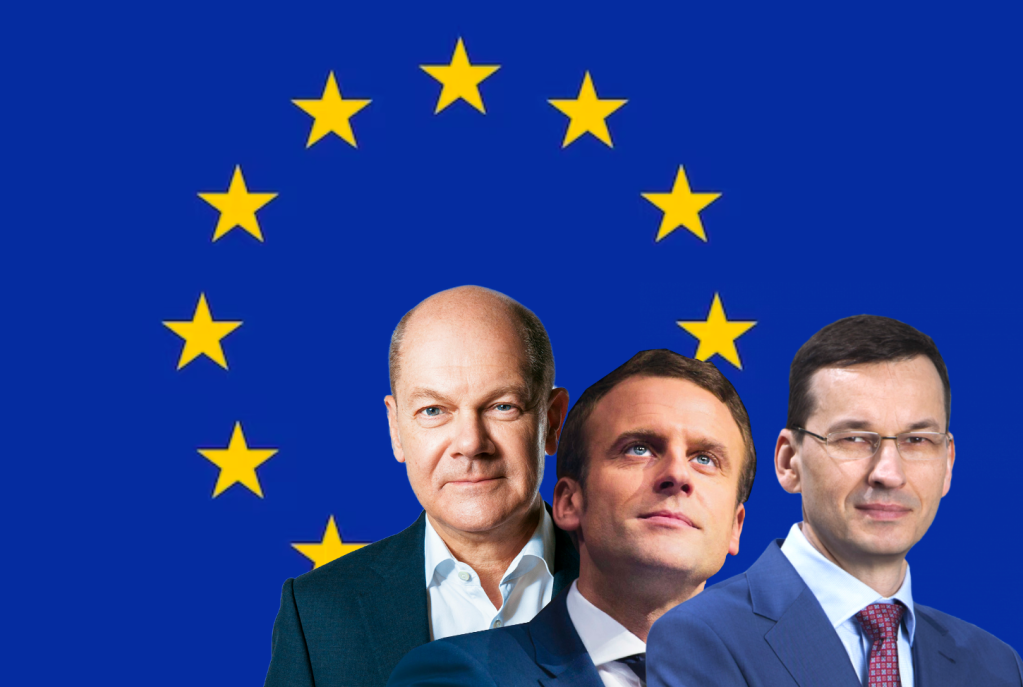
This dissertation was originally titled: To what extent has the war in Ukraine altered the debate and created a consensus among EU member states on European Strategic Autonomy?
Abstract
The invasion of Ukraine in February 2022 sent shockwaves throughout Europe and intensified debates on the credibility of European Strategic Autonomy (ESA). For some, the role of NATO and the US in Ukraine illustrated the futility of realising European power and autonomous capability. For others, ESA remains a valid ambition, albeit one that requires significant shifts in alignment between EU member states. Due to the war’s recency, little has been done to assess to what extent the war in Ukraine has changed member state positionality on ESA and whether a consensus might be emerging. Leveraging constructivism and strategic culture, this paper examines the leadership narratives of France, Germany and Poland to determine whether change is underway and whether a consensus exists.
This research suggests that the war has altered ESA positions. France has increasingly sought to amend its promotion of ESA in light of Eastern European concerns and response to the reality of NATO rejuvenation and the continuing strength of the US’s role in European security. The impact on Germany’s position has been more marked with narratives becoming more aligned with Paris and evidence of increasing confidence in ideation. In the case of Poland, despite support for the idea of European sovereignty, negative attitudes have hardened in response to French remarks concerning potential European responses to worsening tensions between the US and China. Evidence also suggests that while the war has impacted ESA, so has the increasingly tense international situation between the US and China, suggesting the impact of Ukraine requires careful calibration and contextualisation. In terms of consensus, there is evidence that all three states are aligned in the view that autonomy is desired, and it does not mean autonomy from the US or away from NATO – a position that has long existed but has become more prominent in narratives as the war has progressed. However, consensus on the detail behind ESA remains elusive.
Introduction
The scenes of Russian tank columns heading towards Kyiv in February 2022 shocked Western capitals. In response, the European Union (EU), the United States, and other Western allies rallied to the Ukrainian cause. In collaboration with the United States and other nations, the EU enacted a series of sanctions, including, but not limited to, economic restrictions, the closure of EU airspace and ports to Russian aircraft and shipping, prohibitions on exports and imports, and price caps on Russian energy exports. In parallel, the EU released €1 billion in funding from its European Peace Facility (EPF) to enable the purchase of weapons for Ukraine while leveraging the EU’s military staff to manage supply efforts across member states (European Council, 2023). At the time of writing (July 2023), the EU has implemented its eleventh round of sanctions (European Commission, 2023), approved an additional €3.5 billion in funding for military hardware for Ukraine (O’Carroll, 2023) and begun debating the possibility of leveraging seized Russian capital for rebuilding Ukraine after the war (Fleming & Foy, 2023).
The impact of the war is indeed significant. Ukraine has unexpectedly repelled Russian advances, Finland has joined NATO, with Sweden soon to follow, and the EU has broken convention in funding lethal weapon exports. Even the EU’s approach to enlargement has been transformed, with Ukraine assigned ‘candidate status’ for future EU membership in June 2022 (Kaveshnikov, 2022). The EU’s continued cohesion and response to the war has surprised many commentators (Smith, 2022; Gould-Davies, 2023) and reinvigorated and intensified the debate concerning European Strategic Autonomy (ESA) and the EU’s role as a global actor (Dempsey et al., 2023).
For many, the invasion of Ukraine has proved a pivotal moment for the EU. Despite a long history of efforts to realise European autonomy, the intensity of policy debates has increased. In its updated ‘Strategic Compass’, the European External Action Service (EEAS) referred to the war as representing “a tectonic shift in European history” (Strategic Compass, 2022, p. 14). The EU’s High Representative for Foreign Affairs, Josep Borrell, cited the rapidly changing geopolitical landscape in light of Ukraine and called for a “quantum leap forward on security and defence” (Borrell, 2022, cited in Strategic Compass, p. 4). Likewise, Ursula von der Leyen, President of the European Commission in the days after the invasion, claimed, “European security and defence has evolved more in the last six days than in the last two decades” (von der Leyen, 2022, para. 10). French President Macron suggested the invasion would “shake up our Europe” and “signal the start of a new era” (Macron, 2022a, para. 23, 31). Among analysts and politicians, the war represented a pivotal moment for realising the potential for European power transformation.
Despite the war’s recency, questions remain as to whether the war has or will prove a critical juncture for Europe. Notwithstanding the widespread rhetoric concerning ESA, little scholarly attention has been paid to its analysis (Helwig & Sinkkonen, 2022) and almost none as yet concerning the impact of the war on how narratives and positions might be changing. In light of this, this paper aims to ascertain to what extent the war in Ukraine has altered the debate and created a consensus among the EU member states on European Strategic Autonomy.
Before completing the research, the original assumption was that the ongoing war has proved pivotal in changing ESA positionality and developing a consensus among EU member states for what ESA is not, namely independence from the United States, rather than what it is.
To test this hypothesis, this paper focuses on three EU member states: France, Germany and Poland. It adopts constructivism and strategic culture as frameworks and utilises qualitative content analysis to review the political positions of EU member states within speeches, interviews or authored articles by the leaders of each member state.
This paper finds that the war in Ukraine has altered positions on ESA. For example, evidence shows France adapting its promotion of ESA, Germany adopting French vocabulary and a more geopolitical stance and Poland hardening its position in response to French statements concerning Europe’s posture in light of worsening US / China relations. The latter point also illustrates how changes following the invasion should be contextualised given the impact of other international factors beyond Ukraine, such as worsening global tensions. Regarding consensus, evidence suggests a mixed picture. All three states support a more sovereign Europe and one where the US continues to play an important role. The differences emerge in the forms of autonomy Europe should pursue and the policies it should adopt to realise such an ambition.
During the research, there was found to be limited data available concerning Polish views on ESA. In light of this, the section on Poland is notably shorter than that dedicated to France and Germany. It is also vital to caveat any findings, given the risk of analysis derived from a small sample of data.
The first section of this paper contains the literature review, which introduces the debate on ESA and the potential impact of the Ukraine war. The second section outlines the theoretical frameworks and research methodologies and justifies the selection and use of constructivism, strategic culture and qualitative content analysis. The third section presents the research findings and interprets their meaning concerning the paper’s question. The final section concludes the paper and highlights possible opportunities for future research.
Section 1: Literature Review
European Strategic Autonomy
The debate on ESA remains controversial (Lefebvre, 2021) and contentious, especially in the aftermath of the invasion of Ukraine (Dempsey, 2023). There is, however, consensus that the term ‘European Strategic Autonomy’ is difficult to define (Lippert et al., 2019; Damen, 2022; Zandee et al., 2020; Cottey, 2023), with Järvenpää, Major and Sakkov highlighting it as a “buzzword” (Järvenpää et al., 2019, p. 4) and Cottey calling it “amorphous” (Cottey, 2023, para. 1). Damen concurs, pointing out that the term remains “blurred by the variation in terminology” (Damen, 2022, p. 1). Even national leaders are prone to switching or evolving terms, such as President Macron of France using different terms to explain the idea of autonomy. During his visit to China in April 2023, Macron talked of needing to secure Europe’s “strategic autonomy” (Anderlini & Caulcutt, 2023, para. 2), while a month later, in May, he wrote an article in the Financial Times calling for greater efforts to realise “European sovereignty” (Macron, 2023d, para. 4), a term even the European Parliament finds unsuitable given its controversial connotations with national politics (Damen, 2022).
In addition to the various terms in use, its scope has also evolved. Its purview has broadened from a security and defence focus between 2013-2016 to its present scope, including trade, economy and energy (Damen, 2022) and even climate action, technology and health (Helwig & Sinkkonen, 2022). For Franke and Varma, the term’s “vagueness has led to confusion within the union” (Franke & Varma, 2019, p. 11), while Niklas Helwig suggests its ambiguity is a helpful tool for EU member states to avoid taking a definitive position on controversial matters such as European defence (Helwig, 2022). Returning to the focus of this paper on security, defence and foreign affairs, Fiott identifies three different types of European autonomy, including ‘responsibility’ (the ability to collaborate with the US but act independently when required), ‘hedging‘ (building the capabilities in case of US disengagement) and ’emancipation’ (realisation of full military capabilities necessary for independent action), with the latter being the most ambitious and requiring colossal investment in security and defence to enable the EU to become a truly global actor (Fiott, 2018). As a concept, ESA retains different meanings, comes in different forms and remains mired in controversy.
Aside from contested terminology, definitions and forms of autonomy, there are differences in how member states view the idea of ESA. Several commentators have highlighted France as the driving force behind ESA (Brattberg & Valášek, 2019; Drent, 2018; Damen, 2022) while also pointing out the divergence in views, especially among Atlantist-leaning states such as Germany, whose Defence Minister in 2020 called ESA an ‘illusion’ (Helwig & Sinkkonen, 2022) and those in Eastern Europe such as Poland who worry about ESA undermining the existing strategic relationship with the US and NATO (Helwig & Sinkkonen, 2022; Zandee et al., 2020; Brattberg & Valášek, 2019; Cottey, 2023). As Drent suggests, despite perceived French clarity, the concept was often entirely missing from German policy documents (Drent, 2018), illustrating the ambivalent feelings towards the notion within German policy circles. Similarly, Brattberg and Valášek point out that fears of damaging the NATO alliance lead those states opposed to ESA to adopt different terms again, including “responsibility and burden sharing” (Brattberg & Valášek, 2019, p. 13). Fiott highlights the fear among many EU member states about French motives behind promoting ESA, suggesting that many see French efforts on ESA as “simply a mask to advance French defence-industrial interests” (Fiott, 2022, p. 12). Much of the commentary concerning the views of EU member states focuses heavily on the different strategic cultures and how they influence engagement with the idea.
Opportunity for Consensus?
Several academics and analysts have suggested the possibility of consensus on ESA, particularly concerning security and defence. For example, Helwig and Sinkkonen suggest that the term “should not be understood as a binary choice between dependence and independence or engagement and decoupling [From the US]” (Helwig & Sinkkonen, 2022, p. 1). Others concur, arguing that Europe should look to become “separable but not separate” from the US (Billon-Galland, Thomson, 2018, p. 2) and that strategic autonomy is not an either-or approach and can be better explained as existing on a “continuous spectrum” (Brattberg & Valášek, 2019, p. 10) the idea being that debate has begun to coalesce around the notion that autonomy does not necessarily mean independence.
The impact of the war in Ukraine on ESA continues to divide academics and commentators. For some, ESA is “dead” (Davidson, 2022, para 1) or requires a “reality check” (Franke, 2023, para. 25), while for others, Europe could struggle to maintain solidarity after Ukraine and may remain a mere “bit player when it comes to defence and security” (Sikorski, 2023, p. 69). Similarly, the notion of Europe as a capable military power has been derided as an “elusive dream” given the continuing importance of nation-states in conducting and authorising military action (Deni, 2023, para. 21). Stronger critiques claim that President Macron’s attempts at realising ESA had “crashed and burned in Ukraine” given continuing US dominance and weak European diplomacy (Szewczyk, 2022, para. 3). In contrast are those such as Sabatino who argue that the EU’s determination will see the realisation of some degree of autonomy over the coming years (Sabatino, 2023).
However, despite debates among academics, the recency of the war means that very little academic research has been conducted to determine how the views on ESA among member states might be changing following the invasion and whether or not there is an emerging consensus. Engelbrekt argues that there appears to be little movement regarding “deeper convergence of political and strategic culture” (Engelbrekt, 2022, p. 390, 391). While Engelbrekt is correct in pointing to limited tactical advancements in EU military organisation, this paper contends it is reasonable to argue that changes in strategic culture are long-term and that changing narratives at a national level will take time to impact policy formation. Like much of the commentary relating to the views of member states, it remains contextualised within national strategic cultures, which are often seen as rigid and immutable.
Section 2: Research Approach and Methodology
In order to assess changes and to gauge possible consensus, this paper leverages constructivism and strategic culture to guide both research design, aid analysis and contextualise the findings. Before outlining the research methodology and design, it is vital to provide an overview of constructivism and strategic culture and explain their use in this paper.
Constructivism
Constructivism has become increasingly prominent in the study of international relations since the end of the twentieth century (Flockhart, 2012). At its foundation is the belief that the world around us is not preordained and is instead “constructed” by actors (Kratochwil, 2001, p. 17) and that it can change and evolve (Flockhart, 2012). Constructivism brings into international relations the notions and concepts of “ideas, identity and interaction in the international system” (Agius, 2022, p. 74). Constructivism sits in contrast to the realist theory of anarchy and the realist/liberal focus on material power (Agius, 2022). While it recognises the importance of material power, it promotes the necessity to give equal focus to discourse and ideas (Hopf, 1998). In essence, Constructivism takes into consideration more factors and nuances, thereby improving our understanding of the world around us.
As Thomas Risse points out, constructivist thinking has been adopted by those frustrated by more traditional theories that fail to advance understanding of complex political developments such as EU enlargement (Risse, 2004). Proponents of Constructivism suggest it improves comprehension and understanding of events and issues that traditional methods struggle to explain.
Ultimately, Constructivism allows us to do away with the idea that the world comes already assembled and allows analysts to look more closely at identity construction and how politics and international relations can evolve based on the power of ideas and interactions. Given that ESA is an idea and concept, it makes sense to leverage Constructivism, given its focus on ideas, identity and the possibility of change.
In conducting desk research for this dissertation, the prominence of constructivist thinking was evident across many eminent academics who have utilised it in their research on the EU’s evolution. As Risse points out, Constructivism allows for the exploration of discourse and communication, which helps improve understanding of the EU and how its members see themselves and the bloc (Risse, 2004). Niklas Helwig adopted a constructivist approach in evaluating the social explanation for the term Strategic Autonomy (Helwig, 2022), while Csernatoni used it to examine the EU’s adoption of sovereignty and autonomy labels as a way to provoke and drive innovation at a Union level (Csernatoni, 2022). Stahl, Boelde, Nadoll and Jóhannesdóttir also employed Constructivism to assess and evaluate the changing Altantist-Europeanist split within the EU’s Common Foreign and Security Policy (CFSP) (Stahl et al., 2004). Bretherton and Vogler used Constructivism in their groundbreaking study of the EU as a global actor (Bretherton & Vogler, 2006). The prominence of Constructivism within EU studies provides further rationale for its selection as a robust theoretical framework for investigation.
While Constructivism has grown in popularity, it is not without its critics. Some argue that it is more of a social method than an applicable theory such as realism or liberalism (Adler, 1997). Similarly, others contend it lacks clarity on its character as “a theory or an approach” (Agius, 2022, p. 74). The renowned academic Robert Keohance also criticises Constructivism, given that it retains the state as the central actor in international affairs (Keohane, 2000). Despite this, it remains valuable as a conceptual framework. After all, member states remain pivotal in analysing EU politics and ideas, given the continued importance of states (Rynning, 2011) and their role and authority concerning foreign affairs (Deni, 2023). Even with a possible move to EU-qualified majority voting (QMV) on foreign policy (Szép, 2023), the handling of interstate affairs remains a competency of the member states. Given the focus of this paper on the ESA positions of EU member states, it is important to understand each state’s strategic culture to aid analysis and contextualise any findings.
Strategic Culture
Evaluating whether the EU member states’ positions on ESA have changed and if a consensus is emerging requires examination of messaging by national leaders over time. Strategic culture provides a helpful framing in reviewing changes within states, between states and across time.
The notion of strategic culture was first established during the Cold War by political scientist Jack Snyder, who argued that Soviet responses to the US strategy of a limited nuclear strike would differ significantly from US expectations, given the different cultures existing within the Soviet system and mindset (Snyder, 1977). Snyder argued that both sides’ decision-making would be heavily influenced by “different organizational, historical and political contexts” (Snyder, 1977, p. 5). Furthermore, these differences would form an enduring culture through which all future challenges and tactics would be assessed and acted upon (Snyder, 1977). In other words, state behaviour is influenced by unique historical and cultural factors instead of universal principles.
Despite no standard definition for strategic culture (Greathouse, 2010), it is often heavily focused on military matters (Johnston, 1995; Longhurst, 2004). It has also been used to define and explain the foreign policy positions of nation-states within the EU. For example, Hyde-Price points out, “different historical experiences of war have shaped a variety of distinctive strategic cultures in Europe”, influencing how France, Germany and Poland approached and reacted to events such as the war in Iraq (Hyde-Price, 2004, p. 325). Moreover, he points out that while strategic cultures can be stubbornly consistent, they are also open to radical change, especially in light of significant events such as the 2001 terror attacks on the US (Hyde-Price, 2004). Similarly, Stahl et al. point out how Germany embraced a more European position following the end of the Cold War (Stahl et al., 2004).
While Greathouse rightly suggests that constructivist thinkers have not adopted strategic culture due to the prominence of material power embedded within the concept (Greathouse, 2010), it remains a helpful framing given the similar attributes it shares with constructivist thinking, including a focus on ideas, identity and the possibility of political change. The use of Constructivism and strategic culture puts states and their positionality on ESA at the centre of the analysis. The following section will outline the research design in more detail.
Research Parameters
Three member states: France, Germany and Poland, were selected to form the research cohort. They were chosen for several reasons, including their historical differentiating positions within the ESA debate and the differences within their strategic cultures, ensuring the representation of both Atlantist and Europeanist states.
France was picked due to Macron’s championing of ESA since his famous Sorbonne speech in 2017 and France’s key role with Germany in pushing forward European political integration (Lequesne, 2015). France also represents a Europeanist position on defence and security matters where French leaders have traditionally pushed for the Europeanization of NATO (Stahl et al., 2004; Blunden, 2000; Howorth, 2018) and fostered attempts to position France and the EU as independent actors within the Euro-Atlantic community (Blunden, 2000).
Germany was selected due to its close relationship with France and its role as the economic engine of Europe. It was also selected due to its perceived earlier misgivings of French ideas concerning ESA (Kramp-Karrenbauer, 2020). Germany also provided a view that could be analysed from a more Atlantist point of view, given its desire to maintain the trans-Atlantic alliance and its close security relationship with the US (Aggestam, 2000).
Poland was chosen due to its long-standing Atlantist position, given its desire to stay close to the US – a state it sees as the guarantor of its security (Hyde-Price, 2004), open opposition to French attempts at realising military autonomy as part of ESA (Shotter, 2019), and perceived growing power within the EU (Eyal, 2023).
The research subjects included the national leaders of each member state with research objects including speeches, media interviews and articles authored by national leaders. Efforts were made to capture and analyse speeches to prominent forums such as the European Parliament, the Munich Security Conference, and the World Economic Forum. Due to the limited length of this dissertation, the content analysis did not extend to other political leaders within the selected states, allowing for a deeper and more thorough analysis.
The content selected was sourced from trusted government websites. Sources included the Elyseé Palace, the French Ministry for Europe and Foreign Affairs, the German Federal Government, the German Federal Ministry of Defence, and the Government of Poland website. Articles and interviews were selected from reputable global newspapers and publications such as the Economist, Financial Times and Politico. In six instances, the dissertation author translated transcripts with the output verified by a native speaker. The translated content has been highlighted in the table in the appendices.
The research focused on content from November 2016 to July 2023. The start of the period under investigation was selected due to the first mention of ESA within the European Union Global Strategy (EUGS) in 2016 (Council of the European Union, 2016). The end of June 2023 was selected as the cut-off date to provide sufficient time for accessing, collecting and analysing any transcripts and material. The period selected covers both before and after the invasion of Ukraine in February 2022.
Qualitative Content Analysis
In answering the question posed by this paper, a qualitative approach using content analysis was chosen as the most suitable research method. While content analysis is often seen quantitatively as a way of measuring the amount of something (Berger, 1991), it can also be used in a qualitative setting to examine numerous fields, including political messaging and information (Krippendorff, 2004). For Hsieh and Shannon, qualitative content analysis “goes beyond merely counting words” (Hseih & Shannon, 2005, p. 1278), while Risse argues that “to understand and explain social behaviour, we need to take words, language and communicative utterances seriously” (Risse, 2004, p. 164). Furthermore, Hermann points out that “what is not said may be as important as what is said”, suggesting that concepts and topics that suddenly vanish carry their own meaning (Hermann, 2008, p. 156).
As Weber argues, content analysis is a “method that uses a set of procedures to make valid inferences from text” (Weber, 1990, p. 9)—the idea of procedures points to the importance of establishing a precise and methodical approach to research. As Neuendorf argues, this is important to enable the study to be repeated if necessary and to judge the research and the validity of its findings (Neuendorf, 2002). Before analysing the gathered content in detail, it is necessary to define and create a set of codes that will help organise the data, identify trends and determine any patterns. Coding allows the researcher to identify significant language tracts that will help answer the questions posed by the research. Codes are typically “a word or short phrase that symbolically assigns a summative, salient, essence-capturing, and/or evocative attribute for a portion of language-based or visual data” (Saldaña, 2021, p. 5). While Neuendorf is a proponent of ‘priori design’, in other words designing codes and measures before research commences (Neuendorf, 2002), this paper has opted for a hybrid approach utilising both an inductive and deductive method for coding content. This approach is often called “directed content analysis” (Hsieh & Shannon, 2005, p. 1286) and involves creating codes before and during analysis. The benefit of this approach is that it allows for codes to be updated should new information come to light (Saldaña, 2021). This is a useful approach given the limited academic research done to date on the topic and the lack of any existing code work that could act as a foundation for this study.
After the initial round of analysis, codes and their associated extracts were examined to determine themes and patterns that proved or disproved the original assumptions. To identify evolutionary changes in narrative, extracts and their corresponding codes were recorded across a multi-year timeline. It was also important to note any leadership or government changes during the period, given the impact this could have on changes in policy positions. Analysed in the context of each member state’s strategic culture, it was then possible to ascertain what changes had occurred concerning ESA narratives and whether a consensus was emerging.
Below is a visual overview of the research design and its phases.
Visualisation 1.0 Research Design Overview

Section 3: Findings and Analysis
This section will present the research findings and analysis from the French, German and Polish content to ascertain to what extent the war in Ukraine altered the debate and created a consensus among EU member states on ESA. The analysis for each selected member state begins with a short description of the state’s strategic culture before analysing the state’s ESA narratives and themes pre and post-invasion. In light of the limited data available concerning Polish views on ESA, the analysis of the Polish content will inevitably constitute a smaller section and comes with the caveat that indicative findings would benefit from supplementary follow-up research, possibly with a potential widening of research subjects beyond national leaders.
France
For France, Europe plays a pivotal role in French foreign policy, with the political elite broadly supportive of the idea of “Europe puissance” or, in other words, a Europe able to stand alone (Irondelle & Schmitt, 2013, p. 130). The European project (EU) enables France to “retain grandeur and influence beyond what its economic weight might suggest” (Blunden, 2000, p. 19), with the EU, in effect, acting as a “multiplier of French power” (Blunden, 2000, p. 22). For France, a sense of Europeanness, alongside a desire to maintain independence, retain world-class status, defend national territory and project a unique cultural and values-based identity form the pillars of French strategic culture (Zarobny, 2018).
As a leader, Macron consistently exemplifies the notions inherent in French strategic culture. He has consistently promoted the idea of France as a “great power that counts in a multilateral world” (Macron, 2017a, para. 132). He frequently describes France as a “counterweight” (Macron 2017a, para. 10), an “interlocuter” (Macron, 2017a, para. 67), a “mediating power” (Macron, 2018c, para. 137) and a “balancing power” (Macron, 2021b, para. 25; 2022c, para. 14). In line with French strategic culture, Macron aligns French national interests with Europe’s – they are for him the same. He transposes the French idea of balance, arguing in 2019 that “Europe has to think of itself as a ‘balancing power” (Macron, 2019c, para. 46). Similarly, in speaking to Ambassadors in 2017, Macron argued, “For France, Europe is where we must build the instruments of our power” and “Europe is where our sovereignty lies” (Macron, 2017a, para. 68). Macron’s vision for Europe is that of France, albeit on a larger canvas.
In analysing a broad swathe of Macron’s speeches, interviews and articles, several prominent themes on ESA emerge, including;
- European weakness and the possibility of transformation
- The complementary nature of ESA and NATO
- The overhaul of the European defence industry
- Europe’s independent role in an emerging multipolar world order
- Europe as a ‘geopolitical space.’
It is evident that while some themes, such as European weakness and transformation, have remained consistent over the period, others, such as the overhaul of European defence, have intensified and evolved in the aftermath of the invasion. The war has also introduced new themes, including Europe as a geopolitical space – a political concept Macron believes will help accelerate autonomy while relieving the pressure from Russian-fearing states pushing for EU enlargement.
In addition, the analysis also shows that the war has led Macron to recalibrate his promotion of ESA in light of concerns coming from Eastern European states, the rejuvenation of NATO and worsening global tensions. Furthermore, besides the war in Ukraine, research has found that heightened tensions between the US and China have also impacted French narratives on ESA, indicating that Ukraine’s impact on ESA requires careful calibration and contextualisation.
The following section will review each theme in detail.
Theme 1: European Weakness and the Possibility of Transformation
In 2017, Macron introduced his perspective on ESA during his Ambassadors Week and Sorbonne University speech. Macron talked of a “world order turned upside down” (Macron, 2017a, para. 5) with a Europe that was “too weak, too slow, too inefficient” (Macron, 2017b, para. 17) and enfeebled by its role as “a crisis management agency” (Macron, 2017a, para. 79). Macron criticised Europe’s lack of “common strategic culture”, a problem he sees as weakening Europe’s standing in the world (Macron, 2017b, para. 22). Macron returns to the notion of European weakness consistently over subsequent years, referring to Europe’s inability to maintain unity during regular crises, its ineffectual responses to the challenges posed by the globalised economy and its fragility in adjusting to fragmenting world order (Macron, 2018c, para. 132, 134). For Macron, Europe is constantly struggling to meet its never-ending challenges.
In response to Europe’s perceived weaknesses, Macron argued it demanded a “European transformation” (Macron, 2017a, para. 3). He spoke of “rebuilding a sovereign Europe” (Macron, 2017b, para. 17) by realising “six keys to sovereignty”, (Macron, 2017b, para. 19): including security, border control and protection of European values, foreign policy towards Africa, ecological transformation, digital technology, and overhauling European industrial and monetary power (Macron, 2017b). In the subsequent years, Macron has remained consistent in calling for action to secure greater European autonomy calling for a “new strategy for European power” (Macron, 2018a, para. 23), one that would provide for a “European aggiornamento” (Macron, 2019c, para. 12). For Macron, European weakness had reached a point of nadir, with France able to see the opportunity and provide the solution in the form of European autonomy. It enabled Macron to position France as the leader and innovator of European politics – an ambition ingrained in the country’s strategic culture.
The rhetoric concerning European weakness and transformation continued following the invasion. Macron talked about Europe’s dangerous reliance on others, especially in energy and arms and stated the need for Europe to avoid repeating past mistakes on energy dependence (Macron, 2022a). Furthermore, he called for Europe to break its habit of procuring military equipment outside of Europe and promoted the idea of an overhauled homegrown defence industry (Macron, 2022c). From the analysis, it is clear that Macron continues highlighting both European weaknesses and the potential for transformation. If anything, the war and its challenges on defence and energy have provided him with more tangible examples to promote ESA’s benefits.
Theme 2: Complementary nature of ESA and NATO
During the period of increasing tension with President Donald Trump, Macron made the case for Europe to secure an autonomous military capability, albeit in alignment with NATO. Despite the uproar concerning his famous remarks in 2019 to the Economist magazine when he suggested that NATO was experiencing “brain death” (Macron, 2019c, para. 15), Macron has remained consistent in his views on the need for NATO reform. In 2018, he spoke of “the doubts concerning NATO” given the US rhetoric on its durability and commitment to the alliance (Macron, 2018c, para. 57). He openly criticised NATO’s inability to “regulate its members” in response to perceptions of US unilateralism (Macron, 2019c, para. 48) and called for a robust “strategic review of NATO” during his speech to the Ecole de Guerre (Macron, 2020b, para. 43). In the next few years, he continued to argue for reform while stating the complementary nature of attempts at developing an autonomous European capability. Macron frequently described efforts to develop a European defence capability as a “pillar within NATO” (Macron, 2020b, para. 89). For Macron, an autonomous military capability was a way to reduce the tensions within the alliance, improve burden sharing and empower Europe. Looking at the evidence, it can be argued that there never was an intention to replace or jettison NATO or the role of the US, despite widespread accusations to the contrary.
Analysis of French narratives after the invasion shows how Macron has intensified efforts to remind audiences that European military autonomy does not constitute a rupture or desire to duplicate NATO. Macron has strengthened his language and directly challenged what he believes to be the misconceptions surrounding French intentions. In May 2023, he talked of wanting to “debunk all these ideas” concerning the undermining of NATO, arguing that “my goal is in no case to try and replace NATO” and “I do not want to replace NATO with a sort of Franco-German condominium” (Macron, 2023c, para. 22). This more robust remark is undoubtedly aimed at reassuring those in Eastern Europe who have long suspected French intentions and to which earlier appeals have not worked. Looking at his speeches following the invasion, there is a growing sense of exasperation at having to reassure allies of French intentions with ESA.
Analysis shows that the war has also altered how Macron promotes ESA. Macron recalibrated his promotion of ESA to mollify the worries and anxieties of Eastern European states that were annoyed with French responses to Russian aggression and concerned about ESA rhetoric. Macron admitted that France had “sometimes missed opportunities to listen” and was “sometimes seen as being arrogant” (Macron, 2023c, para. 4, 47). This surprisingly frank comment was undoubtedly an attempt at a peace offering to Eastern European states. It was perhaps cognisant of the remark made by German Chancellor Olaf Schulz in 2022, when he suggested that “the centre of Europe is moving Eastward” (Schulz, 2022c, para. 32). In the same speech, Macron thanked the US for providing the bulk of military assistance and reconnaissance (Macron, 2023c, para. 11), a remark no doubt made to temper those who criticise France for failing to recognise the immense importance the US continues to play in European security. The war has influenced how Macron has had to adapt his promotion of ESA by recognising the concerns and suspicions of other European powers, the possibility of a long-term power shift within the EU, the reinvigoration of NATO and the continued role of the US in European affairs.
Theme 3: The Overhaul of the European defence industry
Macron has repeatedly called for an overhaul of European defence. He has highlighted the need for an autonomous military capability and the need to reverse military spending cuts (Macron, 2020b), called for Europe to have a more significant voice in decisions regarding missile defence (Macron, 2020a) and openly discussed the role France’s nuclear deterrent could play in providing for European security (Macron, 2020b). Macron’s comments on European defence reflect a core pillar of France’s strategic culture – its readiness to deploy and use its military power (Irondelle & Schmitt, 2013).
However, following the invasion, the research shows how much more significant and prominent a defence and military focus has become in Macron’s ESA rhetoric. In his national address following the invasion, Macron argued that “European defence must step up” (Macron, 2022a, para. 40). A French-led EU response resulted in the Versailles Declaration in March 2022, where Macron and other EU leaders agreed to a series of measures including, but not limited to, increases in defence spending, more joint EU military procurement and assessment of EU opportunities to bolster European military-industrial production (Versailles Declaration, 2022). Despite previous talk of tactical progress on the issue of military autonomy, the declaration’s EU-wide support and Macron’s spearheading suggest the war may prove pivotal in accelerating practical aspects of ESA. In 2023, Macron further intensified his messaging on European defence, arguing that the war presented a critical moment for Europe to “speed up its ability to produce [arms] on European soil” (Macron, 2023a, para. 18) while accelerating efforts to harmonise and rationalise production within its “war economy” (Macron, 2023a, para. 20). The war has provided Macron with a local neighbourhood war that brings to life the very scenario he has repeatedly used when trying to justify the development of a European military capability.
Theme 4: Europe’s independent role in an emerging multipolar world order
Before the war, Macron consistently promoted the idea of Europe as a ‘power’ and argued that it needed to adapt to a changing world order, especially in light of increasing competition between China and the US. Like German Chancellor Angela Merkel, Macron stated, “Europe can no longer entrust its security to the United States alone” (Macron, 2018c, para. 51). The theme of European independence did not dissipate despite the election of the more pro-European President Biden in 2020. Macron continued pushing for European independence, arguing that Europe could not have its standards dictated by the US, have its assets owned by China (Macron, 2020b), nor “suspend our collective security on the whim of the American voter” (Macron, 2022c, para. 63). Macron has time and again promoted the notion of European separateness while simultaneously recognising the need to balance rhetoric given sensibilities over NATO, the occupant in the White House and evolving US relations with China. It is an approach and practice that aligns closely with French strategic thinking and the idea of France as having a balancing role.
While the invasion of Ukraine has altered French messaging and focus on ESA, analysis shows that worsening relations between the US and China have also had an impact. On visiting China to meet with President Xi in April 2023, Macron remarked to journalists at Politico that taking sides would leave Europe a weakened “vassal”, unable to achieve its own autonomy (Macron, 2023, cited in Anderlini & Caulcutt, 2023, para. 7). It was a call for Europe to shift away from reliance on outside powers and to aggressively pursue the idea of Europe as a “third superpower” (Macron, 2023, cited in Anderlini & Caulcutt, 2023, para. 7). Despite Macron having made regular statements on the need for Europe to retain independent manoeuvrability, his choice of language reflects an intensifying concern in light of worsening global tensions. For Macron, events in Ukraine are not the only factors influencing French thinking on ESA. The analysis shows an increasing tempo of debate on how Europe fits into the US/China rivalry suggesting that the impact of the war in Ukraine on ESA requires careful calibration and contextualisation.
Theme 5: Europe as a Geopolitical Space
Another impact of the war has seen Macron reimagine how autonomy might be accelerated and achieved despite the distracting pressures from those states fearing Russia and pushing for EU enlargement. The war in Ukraine has increased the clamour of calls from Kiyv and other non-EU member states for another round of enlargement (Gehrke, 2022) – something Macron is keen to avoid given the French desire to deepen integration, a process he believes is a prerequisite for effective autonomy (Macron, 2022b). It is reasonable to suggest that for Macron, the push for renewed enlargement posed a risk to efforts at realising autonomy. It would in French minds distract the EU with new member absorption at the expense of much needed institutional Union reform.
In promoting his idea of a European Political Community (EPC), Macron argued it would fulfil a long-held French ambition to “organise Europe from a political perspective and with a broader scope than that of the European Union” (Macron, 2022b, para. 32). Being open to any European state, irrespective of EU membership, would give Europe a “geopolitical space” to engage on issues as diverse as security, energy, migration and infrastructure while preserving the existing shape of the EU so that efforts can be made to solve the challenges and barriers preventing strategic autonomy (Macron, 2022c, para. 66). It can be argued that for Macron, the EPC was like a release valve that removed the pressure for continued enlargement while freeing up political capacity for the EU to focus on the reforms France believes are necessary to ensure autonomy.
Overall, analysis shows that French narratives on ESA have been remarkably consistent. Macron has repeatedly spoken of European weakness, revival, the need for military autonomy in alignment with NATO, and a greater role for Europe on the world stage. However, the invasion of Ukraine has intensified a focus on defence policy while pushing Macron to reach out more openly to Eastern European states, which have felt let down by France and are wary of strategic autonomy. It has also pushed France to reimagine Europe as a ‘geopolitical space’, allowing Macron to propose the EPC to relieve the distraction of further enlargement and thereby accelerate autonomy.
However, while it is reasonable to suggest that the war in Ukraine has emboldened French views and altered its messaging on ESA, it is also clear that worsening tensions between the US and China have influenced the evolution of French messaging surrounding ESA. Ukraine has been fundamental in evolving ESA narratives, but it requires contextualisation given the other global factors affecting French rhetoric.
Germany
Like France, Germany’s strategic culture has been heavily influenced by history. Following the country’s defeat in the Second World War, militarism and nationalism was replaced by “a strong pacifist orientation” (Stahl et al., 2004, p. 432). At the centre of German strategic culture is the importance of its relationship with France and the role the EU plays in empowering German leadership (Techau, 2011). In contrast to France, Germany sees itself as the translating power between European and US ideas of European security (Aggestam, 2000). In line with the notion that strategic culture can change following significant events, Germany has evolved its position on military engagements, becoming more open to military deployments following events in the former Yugoslavia, especially after the war in Kosovo in 1999. (Staun, 2020).
In analysing German leadership narratives across the tenures of Angela Merkel (2017 – 2021) and Olaf Schulz (2021 – present), the most prevalent themes identified were:
- The need for European adjustment
- Intensified German ideation
- Military transformation
- An enlarged, ‘geopolitical EU’
The analysis shows that while Germany shares Macron’s desire to strengthen Europe as a global player, the two states have notable policy differences in areas linked to ESA. Chancellor Angela Merkel rarely used the language adopted by Macron and frequently couched autonomy ideas such as a common foreign policy or a European army as long-term endeavours (Merkel, 2018b). However, the analysis shows a change in focus and tone with the coming to power of Chancellor Olaf Schulz in December 2021, who more openly embraced Macron’s vocabulary and intensified German focus and ideation on ESA.
The analysis finds that the war in Ukraine has led Chancellor Schulz to transform German attitudes toward ESA. There is evidence of a more dramatic alignment with French thinking and a more expansive exploration of the reforms necessary to realise European autonomy, albeit with some divergence from French policy positions, such as enlargement. However, unlike in the French case, German narratives make limited references to Europe’s role in the context of worsening relations between the US and China. – a sign, it could be argued, of Germany’s desire to maintain its Atlantist position while avoiding provoking China.
Theme 1: The Need for European Adjustment
Following the election of US President Trump, Merkel openly expressed the need for Europe to address its over-reliance on the US. In a speech to the European Parliament, she argued: “The times when we could rely on others are over” (Merkel, 2018b, para. 17) and that it was time for Europe to grasp the opportunity for it to develop and cultivate its ability to act in its own interests (Merkel, 2018b). Merkel continued this theme arguing that “old certainties of the post-war order no longer apply” (Merkel, 2019, cited in Kornelius et al,. 2019, para. 3) Like Macron, Merkel pointed out the need for greater cooperation on military matters, arguing that Europe’s overly diverse military systems and assets were holding it back from playing its role in NATO and being able to act alone if necessary, especially in light of worsening relations with the United States (Merkel, 2018b). She promoted various ideas, including a ‘European Security Council’ and a possible European army (Merkel, 2018b), illustrating the German vision for greater European autonomy.
While Merkel has only referred to the term’ sovereignty’ in paraphrasing Macron’s ideas (Merkel, 2018a), Schulz has taken a more overt stance and adopted the same language used by Macron. In one of his first speeches as German Chancellor, he proclaimed Germany’s ambition to achieve “a strong and sovereign Europe” (Schulz, 2021, para. 50). It can be argued that the noticeable mirroring of the French narrative and careful choice of words is evidence that Schulz used one of his first speeches to reset relations over ESA and to pursue alignment with France over an issue that offers the potential for further Franco-German advancement of the EU.
Theme 2: Intensified German Ideation
While Merkel spoke in the past about the need for a European army, greater collaboration on defence and qualified majority voting in foreign policy (Meseberg Declaration, 2018), Schulz has intensified German thinking across a spectrum of policy and reform areas linked to ESA in the aftermath of the invasion of Ukraine.
In August 2022, Schulz called for the realisation of a “geopolitical Europe” and, in a similar fashion to Macron’s efforts at Sorbonne, shared some of his ideas on the future of the EU (Schulz, 2022c, para. 27). His speech was full of ideas on how to improve European autonomy of action, including a shift towards a qualified majority voting in foreign policy, the need to maintain national commissioners, the creation of a unified EU Defence Council made up of Defence Ministers from each member state and the establishment of an EU headquarters for EU deployed armed forces (Schulz, 2022c). While much of this represents continuity with Merkel, it can be argued that the replication in the language used by Macron indicates a convergence with France. The pattern of increasing ideation from Germany shows that the war has fostered a new culture of deepening debate on European autonomy, with Germany taking on a more proactive leadership role – a role more often associated with France.
Theme 3: Military transformation
The war in Ukraine has seen Schulz transform German military policy while linking it to the bigger goal of a more robust and sovereign Europe. Like other Western leaders, Schulz argued that the invasion marked a moment of reckoning in international affairs. In his speech to the Bundestag following the invasion, he called Russian aggression “a watershed in the history of our continent” (Schulz, 2022b, para. 1). In announcing a massive one hundred billion euro investment in the German Bundeswehr, Schulz made clear the criticality of enhancing cooperation and integration with European allies calling for a more significant effort to develop standardised military assets on European soil (Schulz, 2022b). The massive Bundeswehr investment programme represents a step-change to Germany’s former reluctance to invest in military hardware and to support aggressive efforts at European rearmament. Like Macron, Schulz views the war in Ukraine as a pivotal moment in the development of European power, stating, “When, if not now, will we create a sovereign Europe that can hold its own in a multipolar world?” (Schulz 2022c, para. 94). For Schulz, like Marcon, the war is the realisation of fears and points to the necessity and urgency for European autonomy; the need for autonomy is no longer theoretical. It is reasonable to argue that Germany, like France, realises the war’s opportunity to provide further incentive and zeal for reforming and perfecting the EU.
Theme 4: An Enlarged Geopolitical EU
Before the invasion of Ukraine, German ideas concerning European geopolitics were limited. Merkel had spoken of the need for the EU to “take our destiny in our own hands” (Merkel, 2018b, para. 17) and in a newspaper interview for Europe to “reposition itself in a changed world” in light of worsening global tensions (Merkel, 2019, cited in Kornelius et al., 2019, para. 3). In addition, Merkel called the Balkan states awaiting accession to the EU as of “geostrategic interest” given the challenges posed by Russia and China (Merkel, 2021b, min. 0.33). It is open to debate why geopolitical thinking has been largely absent in Germany, but the negative historical connotations with geopolitics may continue to play their role (van der Wusten, 1998), as well as the German strategic culture of practising both Atlanticism and an open door trade policy with Russia.
However, the analysis shows that since the invasion of Ukraine, Germany has become more strident in adopting geopolitical thinking. In August 2022, Schulz stated his aim was to realise a “geopolitical Europe” – one that could contain up to thirty-six member states and a population of half a billion people (Schulz, 2022c, para. 26). He argued for accelerating EU enlargement, claiming it would help “safeguarding peace in Europe” and help strengthen European power (Schulz, 2023b, para. 74). He brushed aside barriers to EU enlargement arguing they could easily be overcome given the experience of amending, adapting and jettisoning long-established conventions in response to Ukraine (Schulz, 2022c)
Furthermore, he suggested that while Macron’s idea of the EPC was a beneficial addition to European intergovernmentalism, it “is not an alternative to the upcoming process of EU enlargement”, especially for countries who, in his view, had waited long enough for accession (Schulz, 2022c, para. 19). In contrast to Macron, Schulz argued that reform and preparation for enlargement would happen simultaneously and that enlargement was essential to achieve a ‘geopolitical Europe’ (Schulz, 2022c).
Moreover, Schulz tied the need for QMV to EU enlargement, arguing that it was vital to bring to an end the “jungle of different rules and complicated opt-ins and opt-outs” that he believes would render an autonomous Europe illusory (Schulz, 2022c, para. 39). For Schulz, in contrast to Macron, EU enlargement is a necessary and critical component of a geopolitical and autonomous EU.
On balance, the analysis shows that the war in Ukraine has had a noticeable impact on Germany’s position concerning ESA. While it is true that Schulz has maintained long-standing policy positions similar to those held during Merkel’s tenure, it is significant how narratives on European sovereignty and autonomy changed following his election and intensified following the Ukraine invasion. After February 2022, Schulz transformed German attitudes and increased investment in defence while amplifying German ideation on ESA. Adopting the idea of a ‘geopolitical Europe’ is much more in tune with the ideas promoted by Macron and represents a significant shift in German thinking. In addition to new ideas, it is interesting to note the alignment between Germany and France in the language both leaders use to promote ESA. Both argue that efforts at realising European military autonomy complement NATO while also couching autonomy within a broader Euro-Atlantic context. However, Germany and France differ in the policy detail, especially around how autonomy can be achieved in light of pressures for EU enlargement. For Schulz, the invasion heralds an opportunity to forge ahead with European sovereignty, including completing further enlargement, albeit with EU internal reforms. In contrast, Macron favours pausing enlargement to accelerate reforms necessary for autonomy. It is in the detail that consensus remains elusive.
Poland
Poland’s strategic culture, like Germany and France, has been heavily influenced by history. Its Atlantic outlook is built on numerous historical factors, including a sense that European allies have in the past failed to protect Poland (Hyde-Price, 2004; Oscia, 2004). Given its historical experience, Poland has prioritised its relationship with the US for its security and has actively supported the US in Afghanistan and Iraq (Hyde-Price, 2004; Oscia, 2004; Chappell, 2010). With the war in Ukraine, Poland feels vindicated in having warned of the Russian danger – a historical danger that forms a crucial part of Poland’s strategic cultural identity (Reeves, 2021). Given Poland’s more Atlantist orientation, it has typically been hostile to French-led ESA rhetoric, especially concerning military matters, with Gotkowska arguing that Poland is, in effect, “a status quo country” in that it wants to retain the US security umbrella while restricting European autonomy efforts that Poland sees as wasteful replication of existing NATO assets (Gotkowska, 2020, p. 66).
In reviewing Polish narratives across the tenures of Prime Minister Beata Szydlo (2015 – 2016) and Mateusz Morawiecki (2017 – present), mentions of ESA are low in number. While it could be argued that the limited data suggests that ESA does not hold the same significance as it does for France and Germany, it also demands caution in attempting to extrapolate findings concerning the Polish position on ESA.
However, despite the limited data available for analysis, the main themes were:
- Support for European sovereignty, but not to the detriment of NATO
- A hardening of attitudes in response to French rhetoric on ESA
Theme 1: Support for European sovereignty, but not to the detriment of NATO
The analysis shows that while not necessarily aligned with French visions of autonomy, Polish leaders have supported the idea of a more sovereign Europe. Prime Minister Morawiecki argued in the European Parliament in 2018 that “Europe should be an entity on the global stage” (Morawiecki, 2018, min. 31:46) and could one day become a “superpower” (Morawiecki, 2019, para. 32). However, the Polish position on ESA remains primarily focused on economic prowess, with Polish Prime Ministers adopting policy positions against deepening EU integration (Morawiecki, 2021), favouring the primacy of the nation-state in decision-making, (Morawiecki, 2019), pushing forward EU enlargement and preventing military developments that could undermine NATO (Szydło, 2017, cited in Kunz, 2020). The primacy of NATO in Polish ESA narratives is consistent throughout the research period. Morawiecki argues that efforts to develop a European security strategy must be “consistent with NATO” (Morawiecki, 2021, para. 20), a position his predecessor also held.
After the invasion, Morawiecki reiterated the value Poland sees in NATO, arguing that “without the involvement of the US and possibly Poland, there would be no Ukraine today” (Morawiecki, 2023a, para. 136). Both Polish Prime Ministers have lived up to Poland’s strategic culture of prioritising the trans-Atlantic alliance and relations with the US over attempts to fashion an independent European military capability. Despite the few mentions concerning ESA, Polish Prime Ministers have consistently supported autonomy, albeit on Polish designs that prioritise economic might, the centrality of nation-states within the Union and limited military efforts that complement NATO. For Poland, analysis shows that the invasion has, if anything, strengthened the case for NATO making talk of European military development even more challenging and contentious.
Theme 2: A hardening of attitudes in response to French rhetoric on ESA
Analysis shows a significant hardening of Polish attitudes concerning ESA especially following remarks made by President Macron on whether the EU would support the US over a potential conflict with Taiwan. Taking swipes at Macron’s vision, Morawiecki remarked to reporters that “instead of building strategic autonomy from the United States, I propose a strategic partnership with the United States” (Morawiecki, 2023, cited in Cienski, 2023, para. 3). Furthermore, he likened Macron’s ESA rhetoric concerning Europe’s relationship between the US and China as akin to “shooting into our own knees”, suggesting that some European allies were giving up dependence on the US in favour of more damaging reliance on China (Morawiecki, 2023b, min. 12:40). The evidence shows that Morawiecki’s views have certainly shifted into more negative terrain since the invasion albeit in reaction to issues broader than just Ukraine. Findings show that the anxiety about China has also influenced Polish rhetoric on ESA.
Overall, Polish sentiment on ESA has hardened since the invasion. However, it is in response to French narratives concerning worsening US/China tensions. It can be argued that French rhetoric has worried Warsaw, resurfacing suspicions of French motives and led to more open disagreement on the forms and terms of autonomy. It is reasonable to assume that the controversy following Macron’s remarks has widened the divide between Poland and France on ESA, making consensus difficult. In relation to Germany, Polish narratives on ESA are scant and remain limited to clashes on policy areas, such as the need for reform ahead of further enlargement.
Conclusion
This paper set out to answer to what extent the war in Ukraine has altered the debate and created a consensus among EU member states on European Strategic Autonomy. On concluding the research, this paper contends that while the war in Ukraine has impacted each member state’s position on ESA to varying degrees, consensus across the member states remains limited.
In the French case, the war has intensified references to defence policy and has seen Macron adjust his messaging on ESA in light of Eastern European concerns regarding the status of NATO within the European security architecture. Macron has also reimagined how EU autonomy might be accelerated by relegating countries desiring EU membership to the EPC, giving the EU the space to achieve autonomy through reform and integration – an approach that both Germany and Poland oppose. Despite Macron’s efforts to evolve his messaging on ESA, his most recent remarks on Europe’s role in the worsening tension between the US and China have only reinforced Polish fears of a French aspiration to detach Europe from the US.
In the German case, while the €100 billion investment in Germany’s military is significant, so too has been the striking alignment on the use of language between Berlin and Paris. Schulz, while having already demonstrated comfort with terms such as ‘European sovereignty’ before the invasion, has intensified the use of terms and positions promoted by France. Even more strikingly, Schulz has pushed Germany into a more ideation role, typically seen as France’s raison d’être on EU matters. Analysis also shows that Germany has adopted a more assertive geopolitical stance which represents a significant shift. However, the war has also seen the continuation of division with France on how to achieve autonomy with differences on policy matters such as enlargement. The evidence shows Schulz regarding the EPC as a useful vehicle for intergovernmentalism but not a forum that should pause enlargement, a process which Germany sees as an essential part of building a global EU.
Despite the limited data, the research shows that Poland, like Germany and France, shares a belief in the need to enhance European power. In contrast to widely held commentary, the research found that Poland is not against ESA. Poland has frequently talked in support of European sovereignty and even the idea of Europe as a superpower. However, reviewing Polish narratives on ESA makes it possible to see continuing policy differences with France and Germany on matters including EU enlargement and reform. The evidence shows Poland has remained close to its strategic culture and maintained its position as an Atlantisist, dismissing notions of EU military independence and favouring more economic themes on ESA. Polish views on ESA have hardened, although this is in response to Macron’s remarks on Europe’s relations between the US and China.
Furthermore, while the war in Ukraine has impacted ESA debates, the worsening tensions between the US and China and, in particular, Macron’s rhetoric in response to it suggest that the war in Ukraine as an influencing factor on the evolution of ESA requires careful calibration and contextualisation.
With the war ongoing, further research on its impact on ESA is necessary. While change is often slow, seismic events such as the invasion of Ukraine can trigger long-term political developments that will take time to emerge. While strategic culture and the positions countries adopt on specific issues can be slow to change, further research is critical to understanding how Europe might evolve over the coming years. As more information becomes available, further research should focus on the evolution of member state positions on ESA, especially in light of changing leaders and the reverberating shockwaves from Ukraine. It is also worth conducting additional research to determine how the EU’s practical responses to the invasion might be changing the understanding of EU actorness. This would be especially useful given how academics and commentators have linked both topics (see: Helwig, 2022; Costa & Barbé, 2023; Fiott, 2022).
Overall, on review of the evidence, the war has noticeably impacted the researched member state’s position on ESA. France has attempted to alter its messaging to recognise Polish concerns and the reality of the continuation of the strength of NATO and the US role in Europe. Germany has adopted French terminology and turned ideational on imagining Europe’s potential future. Poland, in contrast, remains supportive of sovereignty, albeit with limited military autonomy while hardening its position in light of Macron’s opinions on the US and China.
With regard to consensus, the research presents a mixed picture. All three countries have demonstrated a commitment to a stronger, more sovereign Europe, and there is consensus on what ESA is not, namely independence from the US – a view long held even by Macron. The evidence gathered and analysed shows Germany and France growing closer, albeit on terminology and big ideas rather than on policy implementation. On the other hand, Poland has retained its long-held position as an Atlantisist and remains at odds with Paris and Berlin on aspects of ESA. As is often the case with the EU, the member states differ on the forms of autonomy, its necessary preconditions, and the policies and reforms necessary to realise it.
In answering the paper’s question, the research shows that while the war has indeed altered the positions of France, Germany and Poland on ESA, a consensus on the type of autonomy and how to achieve it remains elusive, with differences remaining on the forms, policies and reforms necessary to realise it. Furthermore, while the research shows the fundamental importance of Ukraine in altering positions on ESA, its impact must be contextualised in light of other global pressures that also play a role. With the war in Ukraine still ongoing the long-term ramifications will continue to evolve. It will likely impact more profoundly the positions and consensus among EU member states on ESA.
Bibliography
- A Strategic Compass For Security And Defence. (2022). European External Action Service (EEAS). https://www.eeas.europa.eu/sites/default/files/documents/strategic_compass_en3_web.pdf
- Adler, E. (1997). Seizing the middle ground: Constructivism in world politics. European Journal of International Relations, 3(3), 319–363. https://doi.org/10.1177/1354066197003003003
- Aggestam, L. (2000). Germany. In The Foreign Policies of European Union Member States (pp. 64–83). Manchester University Press.
- Agius, C. (2022). Social Constructivism. In Contemporary Security Studies (Sixth, pp. 74–87). Oxford University Press.
- Anderlini, J., & Caulcutt, C. (2023, April). Europe must resist pressure to become ‘America’s followers’ says Macron [Political news]. Politico. https://www.politico.eu/article/emmanuel-macron-china-america-pressure-interview/
- Bassin, M. (2003). Between realism and the ‘New Right’: Geopolitics in Germany in the 1990s. The Royal Geographical Society, 28(3), 350–366.
- Berger, A. A. (1991). Media research techniques. Sage Publications.
- Billon-Galland, A., & Thomson, A. (2018). European Strategic Autonomy: Stop Talking, Start Planning [Policy Brief]. European Leadership Network. https://www.europeanleadershipnetwork.org/policy-brief/european-strategic-autonomy-stop-talking-start-planning/
- Blunden, M. (2000). France. In The Foreign Policies of European Union Member States (pp. 19–43). Manchester University Press.
- Borrell, J. (2022). A Strategic Compass to Make Europe A Security Provider [Forward to strategy document]. https://www.eeas.europa.eu/sites/default/files/documents/strategic_compass_en3_web.pdf
- Brattberg, E., & Valášek, T. (2019). European Strategic Autonomy and Its Politics. Carnegie Endowment for International Peace. https://www.jstor.org/stable/resrep20973.7?searchText=european+strategic+autonomy+and+its+politics&searchUri=%2Faction%2FdoBasicSearch%3FQuery%3Deuropean%2Bstrategic%2Bautonomy%2Band%2Bits%2Bpolitics&ab_segments=0%2Fbasic_search_gsv2%2Fcontrol&refreqid=fastly-default%3Aa3063682f5c82b79e96a4a2553c42a9f
- Bretherton, C., & Vogler, J. (2006). The European Union as a global actor (2nd ed). Routledge.
- Chappell, L. (2010). Poland in transition: Implications for a european security and defence policy. Contemporary Security Policy, 31(2), 225–248. https://doi.org/10.1080/13523260.2010.491312
- Cienski, J. (2023, April). Poland’s Morawiecki plays Europe’s anti-Macron in Washington. Politico. https://www.politico.eu/article/poland-mateusz-morawiecki-europe-anti-emmanuel-macron-france-washington-china-relations/
- Costa, O., & Barbé, E. (2023). A moving target. EU actorness and the Russian invasion of Ukraine. Journal of European Integration, 45(3), 431–446. https://doi.org/10.1080/07036337.2023.2183394
- Cottey, A. (2023). EU Strategic Autonomy, including its implications for EU cooperation on defence and security. Oireachtas Ireland . https://data.oireachtas.ie/ie/oireachtas/committee/dail/33/joint_committee_on_european_union_affairs/submissions/2023/2023-03-22_opening-statement-prof-andrew-cottey-department-of-government-and-politics-university-college-cork_en.pdf
- Csernatoni, R. (2022). The EU’s hegemonic imaginaries: From European strategic autonomy in defence to technological sovereignty. European Security, 31(3), 395–414. https://doi.org/10.1080/09662839.2022.2103370
- Damen, M. (2022). EU Strategic Autonomy 2013—2023—From concept to capacity. European Parliament . https://www.europarl.europa.eu/RegData/etudes/BRIE/2022/733589/EPRS_BRI(2022)733589_EN.pdf
- Davidson, J. (2022, June). European Strategic Autonomy Is Dead. National Interest. https://nationalinterest.org/feature/european-strategic-autonomy-dead-203222
- Dempsey, J. (2023, January). Judy Asks: Is European Strategic Autonomy Over? [Forum Discussion]. https://carnegieeurope.eu/strategiceurope/88838
- Deni, J. (2023, January). Is European Strategic Autonomy Over? [Forum contribution to debate]. https://carnegieeurope.eu/strategiceurope/88838
- Diner, D. (2000). Knowledge of Expansion—On the Geopolitics of Karl Haushofer. In Beyond the Conceivable: Studies on Germany, Nazism, and the Holocaust (pp. 26–48). University of California Press.
- Drent, M. (2018). European Strategic Autonomy: Going it alone? Clingendael. https://www.jstor.org/stable/resrep21311?searchText=european+strategic+autonomy+going+it+alone&searchUri=%2Faction%2FdoBasicSearch%3FQuery%3Deuropean%2Bstrategic%2Bautonomy%2Bgoing%2Bit%2Balone&ab_segments=0%2Fbasic_search_gsv2%2Fcontrol&refreqid=fastly-default%3A9a577108a2d9ec370ae8eae395ab7c24
- Engelbrekt, K. (2022). Beyond burdensharing and european strategic autonomy: Rebuilding transatlantic security after the ukraine war. European Foreign Affairs Review, 27(Issue 3), 383–400. https://doi.org/10.54648/EERR2022028
- EU adopts 11th package of sanctions against Russia for its continued illegal war against Ukraine. (2023, June). [News announcements]. European Commission Press Corner ; European Commission. https://ec.europa.eu/commission/presscorner/detail/en/ip_23_3429
- EU Response to Russia’s Invasion of Ukraine. (2023, June). [European Council of the European Union ]. https://www.consilium.europa.eu/en/policies/eu-response-ukraine-invasion/#sanctions
- Eyal, J. (2023, January). Amid the smoke of war, power in Europe is shifting decisively to the East. Observer. https://www.theguardian.com/commentisfree/2023/jan/29/amid-the-smoke-of-war-power-in-europe-is-shifting-decisively-to-the-east
- Fiott, D. (2018). Strategic autonomy: Towards ‘European sovereignty’ in defence? European Union Institute for Security Studies (EUISS). https://www.jstor.org/stable/resrep21120?searchText=daniel+fiott&searchUri=%2Faction%2FdoBasicSearch%3FQuery%3Ddaniel%2Bfiott&ab_segments=0%2Fbasic_search_gsv2%2Fcontrol&refreqid=fastly-default%3Abde23e18b5a956a8167a37194d9c561d
- Fiott, D. (2022). Beyond Autonomy: Rethinking Europe as a Strategic Actor (pp. 11–18). LSE Ideas & Friedrich Naumann Foundation. https://www.lse.ac.uk/ideas/publications/reports/beyond-autonomy
- Fleming, S., & Foy, H. (2023, January). EU to examine seizing confiscated Russian assets for reconstruction. Financial Times. https://www.ft.com/content/dab0fe80-dae0-4973-88ea-de2d95cd9a4a
- Flockhart, T. (2012). Constructivism and Foreign Policy. In Foreign Policy—Theories, Actors, Cases (Second, pp. 78–93). Oxford University Press.
- Franke, U. (2023, January). Judy Asks: Is European Strategic Autonomy Over? [Debate contribution]. https://carnegieeurope.eu/strategiceurope/88838
- Franke, U., & Varma, T. (2019). Independence Play: Europe’s Pursuit of Strategic Autonomy. European Council on Foreign Relations . https://ecfr.eu/special/independence_play_europes_pursuit_of_strategic_autonomy/
- Gehrke, L. (2022, March). Georgia, Moldova follow Ukraine in applying to join EU. Politico. https://www.politico.eu/article/georgia-and-moldova-apply-for-eu-membership/
- Gotkowska, J., Zandee, D., Deen, B., Kruijver, K., & Stoetman, A. (2020). Annex 3: Poland and the European strategic autonomy debate (European Strategic Autonomy in Security and Defence, pp. 63–67). Clingendael Institute. https://www.jstor.org/stable/resrep27515.12
- Gould-Davies, N. (2023). The Astonishing Endurance of Unity on Ukraine. Foreign Affairs. https://www.foreignaffairs.com/ukraine/astonishing-endurance-unity-ukraine
- Greathouse, C. B. (2010). Examining the role and methodology of strategic culture. Risk, Hazards & Crisis in Public Policy, 1(1), 55–83. https://doi.org/10.2202/1944-4079.1020
- Helwig, N. (2022). The ambiguity of the EU’s global role: A social explanation of the term ‘strategic autonomy’. European Foreign Affairs Review, 27(Special Issue), 21–38. https://doi.org/10.54648/EERR2022010
- Helwig, N., & Sinkkonen, V. (2022). Strategic autonomy and the EU as a global actor: The evolution, debate and theory of a contested term. European Foreign Affairs Review, 27(Special Issue), 1–20. https://doi.org/10.54648/EERR2022009
- Hermann, M. (2008). Content Analysis . In Qualitative Methods in International Relations—A Pluralist Guide (First, pp. 151–167). Palgrave Macmillan.
- Hopf, T. (1998). The promise of constructivism in international relations theory. International Security, 23(1), 171–200. https://doi.org/10.1162/isec.23.1.171
- Howorth, J. (2018). Strategic autonomy and EU-NATO cooperation: Threat or opportunity for transatlantic defence relations? Journal of European Integration, 40(5), 523–537. https://doi.org/10.1080/07036337.2018.1512268
- Hsieh, H.-F., & Shannon, S. E. (2005). Three approaches to qualitative content analysis. Qualitative Health Research, 15(9), 1277–1288. https://doi.org/10.1177/1049732305276687
- Hyde-Price, A. (2004). European security, strategic culture, and the use of force. European Security, 13(4), 323–343. https://doi.org/10.1080/09662830490499993
- Irondelle, B., & Schmitt, O. (2013). France. In Strategic Cultures in Europe: Security and Defence Policies Across the Continent (pp. 125–137). Springer.
- Järvenpää, P., Major, C., & Sakkov, S. (2019). European Strategic Autonomy Operationalising a Buzzword [Position Paper]. Konrad Adenauer Stiftung. https://icds.ee/wp-content/uploads/2019/10/ICDS_Report_European_Strategic_Autonomy_J%C3%A4rvenp%C3%A4%C3%A4_Major_Sakkov_October_2019.pdf
- Johnston, A. I. (1995). Thinking about strategic culture. International Security, 19(4), 32. https://doi.org/10.2307/2539119
- Kaveshnikov, N. Yu. (2022). Ukraine’s membership application as a trigger to reform the EU enlargement policy. Herald of the Russian Academy of Sciences, 92(S7), S651–S659. https://doi.org/10.1134/S1019331622130032
- Keohane, R. O. (2000). Ideas part-way down. Review of International Studies, 26(1), 125–130. https://doi.org/10.1017/S026021050000125X
- Kornelius, S., Fried, N., & Oltermann, P. (2019, May). Merkel: Europe must unite to stand up to China, Russia and US. Guardian. https://www.theguardian.com/world/2019/may/15/angela-merkel-interview-europe-eu-unite-challenge-us-russia-china
- Kramp-Karrenbauer, A. (2020). Speech by Federal Minister of Defence [Speech].
- Kratochwil, F. (2001). Constructivism as an Approach to Interdisciplinary Study. In Constructing International Relations—The next generation (1st edition, pp. 13–35). Routledge.
- Krippendorff, K. (2004). Content analysis: An introduction to its methodology (2nd ed). Sage.
- Kunz, B. (n.d.). Europe’s Defense Debate Is All About America [National security commentary ]. War on the Rocks. https://warontherocks.com/2020/03/europes-defense-debate-is-all-about-america/
- Lacoste, Y., Rössler, M., & Wolf, M. (1990). Geographie und politisches Handeln: Perspektiven einer neuen Geopolitik. Wagenbach.
- Lefebvre, M. (2021). Europe as a power, European sovereignty and strategic autonomy: A debate that is moving towards an assertive Europe [Policy Paper]. Robert Schuman Foundation. https://www.robert-schuman.eu/en/doc/questions-d-europe/qe-582-en.pdf
- Lequesne, C. (2015). France and the European Union: A story of reason rather than love. Norwegian Institute for International Affairs (NUPI). http://www.jstor.org/stable/resrep07972
- Lippert, B., Von Ondarza, N., Perthes, V., & Stiftung Wissenschaft Und Politik. (2019). European strategic autonomy: Actors, issues, conflicts of interests. SWP Research Paper. https://doi.org/10.18449/2019RP04
- Longhurst, K. A. (2004). Germany and the use of force. Manchester University Press.
- Macron, E. (2017a, August). Ambassadors Week Speech 2017. https://www.diplomatie.gouv.fr/en/the-ministry-and-its-network/news/ambassadors-week/prior-editions/ambassadors-week-edition-2017/speech-by-president-emmanuel-macron-ambassadors-week-2017/
- Macron, E. (2017b, September). Speech on New Initiative for Europe. https://www.elysee.fr/en/emmanuel-macron/2017/09/26/president-macron-gives-speech-on-new-initiative-for-europe
- Macron, E. (2018a, January). Speech by the French President at the World Economic Forum in Switzerland. https://www.elysee.fr/en/emmanuel-macron/2018/01/24/speech-by-the-french-president-at-the-world-economic-forum-in-switzerland-on-january-24-2018
- Macron, E. (2018b, April). Speech by President of the Republic at European Parliament. https://www.elysee.fr/en/emmanuel-macron/2018/04/17/speech-by-emmanuel-macron-president-of-the-republic-at-european-parliament
- Macron, E. (2018c, August). Ambassadors Conference Speech 2018. https://www.diplomatie.gouv.fr/en/the-ministry-and-its-network/news/ambassadors-week/ambassadors-week-edition-2018/article/speech-by-president-emmanuel-macron-ambassadors-conference-2018
- Macron, E. (2019a, March). For European Renewal. https://www.elysee.fr/en/emmanuel-macron/2019/03/04/for-european-renewal
- Macron, E. (2019b, May). A new order for Europe. https://www.elysee.fr/en/emmanuel-macron/2019/05/28/a-new-order-for-europe
- Macron, E. (2019c, November). Emmanuel Macron in his own words [The Economist Magazine ]. https://www.economist.com/europe/2019/11/07/emmanuel-macron-in-his-own-words-english
- Macron, E. (2020a, February). Speech at the Munich Conference on Security . Munich Security Conference , Munich. https://www.elysee.fr/emmanuel-macron/2020/02/15/conference-sur-la-securite-de-munich-faire-revivre-leurope-comme-une-puissance-politique-strategique
- Macron, E. (2020b, February). Speech of the President of the Republic on the Defense and Deterrence Strategy. https://www.elysee.fr/en/emmanuel-macron/2020/02/07/speech-of-the-president-of-the-republic-on-the-defense-and-deterrence-strategy
- Macron, E. (2020c, November). President Macron interviewed by Le Grand Continent [Political Journal]. https://www.diplomatie.gouv.fr/en/french-foreign-policy/news/2020/article/president-macron-interviewed-by-le-grand-continent-12-nov-2020
- Macron, E. (2021a, May 31). Franco-German Council of Ministers. https://www.elysee.fr/emmanuel-macron/2021/05/31/conseil-des-ministres-franco-allemand-du-31-mai-2021
- Macron, E. (2021b, July). Discours en l’honneur des défilants du 14 juillet 2021, depuis le Cercle National des Armées. https://www.elysee.fr/emmanuel-macron/2021/07/13/discours-en-lhonneur-des-defilants-du-14-juillet-2021-depuis-le-cercle-national-des-armees
- Macron, E. (2021c, December). Conseil Européen du 16 Décembre 2021. https://www.elysee.fr/emmanuel-macron/2021/12/17/conseil-europeen-du-16-decembre-2021
- Macron, E. (2022a, March). Address to the Nation. https://www.elysee.fr/en/emmanuel-macron/2022/03/02/address-to-the-nation
- Macron, E. (2022b, May). Speech at the closing ceremony of the Conference on the Future of Europe. https://lv.ambafrance.org/Speech-by-Emmanuel-Macron-at-the-closing-ceremony-of-the-Conference-on-the
- Macron, E. (2022c, September). Ambassadors Conference 2022. https://www.elysee.fr/en/emmanuel-macron/2022/09/01/speech-by-the-president-of-the-french-republic-at-the-conference-of-ambassadors-1
- Macron, E. (2022d, November). À Toulon, le Président de la République présente la Revue nationale stratégique. https://www.elysee.fr/emmanuel-macron/2022/11/09/a-toulon-le-president-de-la-republique-presente-la-revue-nationale-strategique
- Macron, E. (2023a, February). Munich Security Conference . https://www.elysee.fr/admin/upload/default/0001/14/49a39d55783d5cf816c4e7287ba99e478640b7b4.pdf
- Macron, E. (2023b, April). Interview with French President [Politico Magazine ]. https://www.politico.eu/article/emmanuel-macron-china-america-pressure-interview/
- Macron, E. (2023c, May). Closing speech by President of the French Republic at GLOBSEC. https://www.elysee.fr/en/emmanuel-macron/2023/06/01/globsec-summit-in-bratislava
- Macron, E. (2023d, May). Europe needs more factories and fewer dependencies . The Financial Times. https://www.ft.com/content/7ff1123d-51b1-482c-ba86-b3a95a347df9
- Merkel , A. (2020, July). Speech by Federal Chancellor Angela Merkel on the German Presidency of the Council of the EU 2020. https://www.bundesregierung.de/breg-en/service/archive/speech-by-federal-chancellor-angela-merkel-on-the-german-presidency-of-the-council-of-the-eu-2020-to-the-european-parliament-in-brussels-on-8-july-2020-1768008
- Merkel, A. (2017, February). Munich Security Conference . Munich Security Conference , Munich. https://www.bundesregierung.de/breg-en/service/archive/archive/speech-by-federal-chancellor-dr-angela-merkel-on-18-february-2017-at-the-53rd-munich-security-conference-415114
- Merkel, A. (2018a, May). Speech at ceremony awarding the International Charlemagne Prize to French President Emmanuel Macron. https://www.bundesregierung.de/breg-en/service/archive/speech-by-federal-chancellor-dr-angela-merkel-at-the-ceremony-awarding-the-international-charlemagne-prize-to-french-president-emmanuel-macron-in-aachen-on-10-may-2018-1008554
- Merkel, A. (2018b, November). Speech to the European Parliament. https://www.bundesregierung.de/breg-en/service/archive/speech-by-federal-chancellor-angela-merkel-to-the-european-parliament-strasbourg-13-november-2018-1550688
- Merkel, A. (2019a, February). Munich Security Conference . Munich Security Conference , Munich. https://www.bundesregierung.de/breg-en/service/archive/speech-by-federal-chancellor-dr-angela-merkel-on-16-february-2019-at-the-55th-munich-security-conference-1582318
- Merkel, A. (2019b, May). Interview with German Chancellor [Süddeutsche Zeitung, Guardian (Europa Newspaper Alliance)]. https://www.theguardian.com/world/2019/may/15/angela-merkel-interview-europe-eu-unite-challenge-us-russia-china
- Merkel, A. (2019c, May). Merkel: Europe must unite to stand up to China, Russia and US [Newspaper]. https://www.theguardian.com/world/2019/may/15/angela-merkel-interview-europe-eu-unite-challenge-us-russia-china
- Merkel, A. (2021a, February). Munich Security Conference . Munich Security Conference, Munich. https://www.bundesregierung.de/breg-en/service/archive/speech-by-federal-chancellor-dr-angela-merkel-during-the-munich-security-conference-special-edition-on-19-february-2021-video-conference–1861248
- Merkel, A. (2021b, October). Merkel: WBalkans in EU of ‘immense geostrategic interest’ [AP Archive ]. EU Summit , Slovenia. https://www.youtube.com/watch?v=0TC9ls67vRc
- Meseberg Declaration. (2018). Meseberg Declaration . https://www.astrid-online.it/static/upload/mese/meseberg-declaration_en-fr_19_06_18.pdf
- Morawiecki, M. (2018, November). Debating the Future of Europe with Mateusz Morawiecki. https://www.youtube.com/watch?v=RJXJyt9vcqc
- Morawiecki, M. (2019, April). Poland’s vision for Europe. Politico. https://www.politico.eu/article/poland-vision-for-europe-mateusz-morawiecki/
- Morawiecki, M. (2021, October). Statement by Prime Minister Mateusz Morawiecki in the European Parliament. https://www.gov.pl/web/primeminister/statement-by-prime-minister-mateusz-morawiecki-in-the-european-parliament
- Morawiecki, M. (2022a, February). Polish PM: Europe must abandon all illusions about Russia. The Financial Times . https://www.ft.com/content/315a342d-d646-4061-ab4a-d2455b6a7221
- Morawiecki, M. (2022b, October). Interview with Poland Prime Minister Mateusz Morawiecki—Leadership During Crisis [The Washington Post ]. https://www.washingtonpost.com/washington-post-live/2022/10/25/transcript-leadership-during-crisis-with-poland-prime-minister-mateusz-morawiecki/
- Morawiecki, M. (2023a, March). Mateusz Morawiecki at Heidelberg University—’Europe at a historic turning point’. https://www.gov.pl/web/primeminister/mateusz-morawiecki-at-heidelberg-university—europe-at-a-historic-turning-point
- Morawiecki, M. (2023b, April). A Conversation with Prime Minister of Poland Mateusz Morawiecki. Atlantic Council. https://www.youtube.com/watch?v=215cicp8Pmw
- Neuendorf, K. A. (2002). The content analysis guidebook. Sage Publications.
- O’Carroll, L. (2023, May). EU discusses earmarking €1bn for Ukraine. Guardian. https://www.theguardian.com/world/2023/may/23/eu-discusses-earmarking-1bn-for-ukraine
- Osica, O. (2004). Poland: A new European Atlanticist at a crossroads? European Security, 13(4), 301–322. https://doi.org/10.1080/09662830490499984
- Reeves, C. (2021). Discerning poland’s contemporary strategic culture: An analysis of the 2020 national security strategy of the republic of poland. Politeja, 75, 283–305. https://www.jstor.org/stable/27111785
- Risse, T. (2004). Social Constructivism and European Integration. In European Integration Theory (pp. 159–176). Oxford University Press.
- Rynning, S. (2011). Strategic culture and the common security and defence policy – a classical realist assessment and critique. Contemporary Security Policy, 32(3), 535–550. https://doi.org/10.1080/13523260.2011.623057
- Sabatino, E. (2023, January). Is European Strategic Autonomy Over? [Forum contribution to debate]. https://carnegieeurope.eu/strategiceurope/88838
- Saldaña, J. (2021). The coding manual for qualitative researchers (4E [Fourth editiion]). SAGE Publishing Inc.
- Schulz, O. (2021, December). New Year’s Address 2021. https://www.bundeskanzler.de/resource/blob/1833748/1994348/a5aabd0ef1d4b5321f862664b862cbfb/download-pdf-data.pdf?download=1
- Schulz, O. (2022a, February). Munich Security Conference . Munich Security Conference , Munich. https://www.bundesregierung.de/breg-de/impressum/speech-by-olaf-scholz-chancellor-of-the-federal-republic-of-germany-and-member-of-the-german-bundestag-at-the-munich-security-conference-2006670
- Schulz, O. (2022b, February). Policy Statement by Chancellor of the Federal Republic of Germany and Member of the German Bundestag. https://www.bundesregierung.de/breg-en/news/policy-statement-by-olaf-scholz-chancellor-of-the-federal-republic-of-germany-and-member-of-the-german-bundestag-27-february-2022-in-berlin-2008378
- Schulz, O. (2022c, August). Speech by Federal Chancellor Olaf Schulz at the Charles University in Prague . https://www.bundesregierung.de/breg-en/news/scholz-speech-prague-charles-university-2080752
- Schulz, O. (2023a, February). Munich Security Conference. Munich Security Conference, Munich. https://www.bundesregierung.de/breg-en/news/speech-by-chancellor-scholz-at-the-munich-security-conference-on-17-february-2023-in-munich-2166536
- Schulz, O. (2023b, May). Address by Olaf Schulz, Chancellor of the Federal Republic of Germany as part of the European Parliament’s series of plenary debates ‘This is Europe’. https://www.bundesregierung.de/breg-en/news/address-by-olaf-scholz-2189412
- Shared Vision, Common Action: A Stronger Europe. (2016). Council of the European Union. https://eeas.europa.eu/archives/docs/top_stories/pdf/eugs_review_web.pdf
- Shotter, J. (2019, November). Poland’s prime minister brands Macron ‘irresponsible’ on NATO. Financial Times. https://www.ft.com/content/a0a71b16-03a1-11ea-a984-fbbacad9e7dd
- Sikorski, R. (2023). Europe’s Real Test Is Yet To Come. Foreign Affairs, 102(4), 66–77.
- Smith, J. (2022, March). [Harvard Kennedy School]. Ukraine War Prompts Surprising Unity in Europe on Need for Bolstered Defence. https://www.hks.harvard.edu/faculty-research/policy-topics/international-relations-security/ukraine-war-prompts-surprising
- Smith, N. (2003). Geopolitics: The Reassertion of Old World Geographies. In American Empire: Roosevelt’s Geographer and the Prelude to Globalization (pp. 272–292). University of California Press.
- Snyder, J. (1977). The Soviet Strategic Culture: Implications for Limited Nuclear Operations. Rand Corp. https://www.rand.org/content/dam/rand/pubs/reports/2005/R2154.pdf
- Stahl, B., Jóhannesdóttir, A., Boekle, H., & Nadoll, J. (2004). Understanding the atlanticist–europeanist divide in the cfsp: Comparing denmark, france, germany and the netherlands. European Foreign Affairs Review, 9(Issue 3), 417–441. https://doi.org/10.54648/EERR2004030
- Staun, J. (2020). The slow path towards ‘normality’: German strategic culture and the holocaust. Scandinavian Journal of Military Studies, 3(1), 84–99. https://doi.org/10.31374/sjms.34
- Szép , V. (2023, May). [Think Tank ]. Making EU Foreign Policy More Effective: Qualified Majority Voting on the Horizon? https://carnegieeurope.eu/strategiceurope/89652
- Szewczyk, B. (2022, April). Macron’s European Vision Crashed and Burned in Ukraine. Foreign Policy. https://foreignpolicy.com/2022/04/08/macron-putin-france-russia-ukraine-europe-sovereignty-strategy/
- Techau, J. (2011). No Strategy, Please, We’re German. In Towards a Comprehensive Approach: Strategic and Operational Challenges (pp. 69–93). NATO Defence College. https://carnegieendowment.org/files/The_Eight_Elements_That_Shaped_German_Strategic_Culture1.pdf
- van der Wusten, H. (1998). Geopolitics: Its different faces, its renewed popularity . GeoJournal, 46(4), 233–235.
- Versailles Declaration. (2022). Versailles Declaration—Information meeting of the Heads of State or Government. https://www.consilium.europa.eu/media/54773/20220311-versailles-declaration-en.pdf
- von der Leyen, U. (2022). Speech by President von der Leyen at the European Parliament Plenary on the Russian aggression against Ukraine [Speech]. https://cyprus.representation.ec.europa.eu/news/speech-president-von-der-leyen-european-parliament-plenary-russian-aggression-against-ukraine-2022-03-01_en
- Weber, R. (1990). Basic content analysis. SAGE Publications, Inc. https://doi.org/10.4135/9781412983488
- Zandee, D., Deen, B., Kruijver, K., & Stoetman, A. (2020). European Strategic Autonomy in Security and Defence. Clingendael Institute. https://www.jstor.org/stable/resrep27515.5
- Zarobny, S. (2018). Changes in france’s strategic culture after the cold war. Kultura Bezpieczeństwa. Nauka – Praktyka – Refleksje, 32(32), 273–292. https://doi.org/10.5604/01.3001.0012.8105
Annex
Below is a list of data used in the research. Format of sources has also been listed together with those sources that were translated (T)
| Leader | Speech (S) / Interview (I) / Article (A) | Date |
| France | ||
| Emmanuel Macron | Ambassadors Week (S) | 29th August 2017 |
| New Initiative for Europe (Sorbonne University) (S) | 26th September 2017 | |
| World Economic Forum (S) | 24th January 2018 | |
| European Parliament (S) | 17th April 2018 | |
| Ambassadors Conference (S) | 27th August 2018 | |
| European Renewal (S) | 4th March 2019 | |
| Statement At Arrival at European Council (S) | 28th May 2019 | |
| Economist Interview (I) | 7th November 2019 | |
| Defence & Deterrence Strategy Ecole de Guerre (S) | 7th February 2020 | |
| Munich Security Conference (I) (T) | 15th February 2020 | |
| Le Grand Continent (I) | 12th November 2020 | |
| Franco-German Council of Ministers (S) (T) | 31st May 2021 | |
| Bastile Day (S) (T) | 14th July 2021 | |
| European Council (S) (T) | 16th December 2021 | |
| Address to the Nation (S) | 2nd March 2022 | |
| Future of Europe, Strasbourg (S) | 9th May 2022 | |
| Ambassadors Conference (S) | 1st September 2022 | |
| National Security Strategy (S) (T), Toulon Naval Base | 9th November 2022 | |
| Munich Security Conference (S) | 17th February 2023 | |
| Politico Interview China Visit (I) | 9th April 2023 | |
| Europe Needs More Factories and Fewer Dependencies (A) | 11th May 2023 | |
| Global Security Conference, Bratislava (S) | 31st May 2023 | |
| Germany | ||
| Angela Merkel | Munich Security Conference | 18th February 2017 |
| International Charlemagne Prize Award (S) | 10th May 2018 | |
| Future of Europe, European Parliament, Strasbourg, (S) | 13th November 2018 | |
| Munich Security Conference (S) | 16th February 2019 | |
| Guardian & European Press Interview (I) | 15th May 2019 | |
| German Presidency of the Council of the EU 2020 | 8th July 2020 | |
| German Presidency of the Council of the EU Committee of the Regions | 13th October 2020 | |
| Munich Security Conference (S) | 19th February 2021 | |
| Olaf Schulz | New Year Address Olaf Schulz (S) | 31st December 2021 |
| Munich Security Conference (S) | 19th February 2022 | |
| Policy Statement to Bundestag (S) | 27th February 2022 | |
| Charles University, Prague (S) | 29th August 2022 | |
| Munich Security Conference (S) | 17th February 2023 | |
| This Is Europe, European Parliament, Strasbourg (S) | 9th May 2023 | |
| Poland | ||
| Beata Szydło | Remarks on ESA (cited in Kunz, 2020) see bibliography | Exact date unknown |
| Mateusz Morawiecki | Speech to the European Parliament, Strasbourg (S) (T) | 13th November 2018 |
| Poland’s vision for Europe, Politico (A) | 30th April 2019 | |
| Interview with Financial Times (I) | 10th November 2019 | |
| Statement to European Parliament, Brussels (S) | 19th October 2021 | |
| Europe Must Abandon All Illussions About Russia, Financial Times (A) | 25th February 2022 | |
| Interview with David Ignatius, Washington Post (I) | 25th October 2022 | |
| Heidelberg University (S) | 20th March 2023 | |
| Atlantic Council Think Tank (S) accessed via YouTube | 14th April 2023 | |
| Additional Documents | ||
| Meseberg Franco-German Declaration | 19th June 2018 | |
| Versailles Declaration | 11th March 2022 | |
 The Pamphlet
Leave a comment